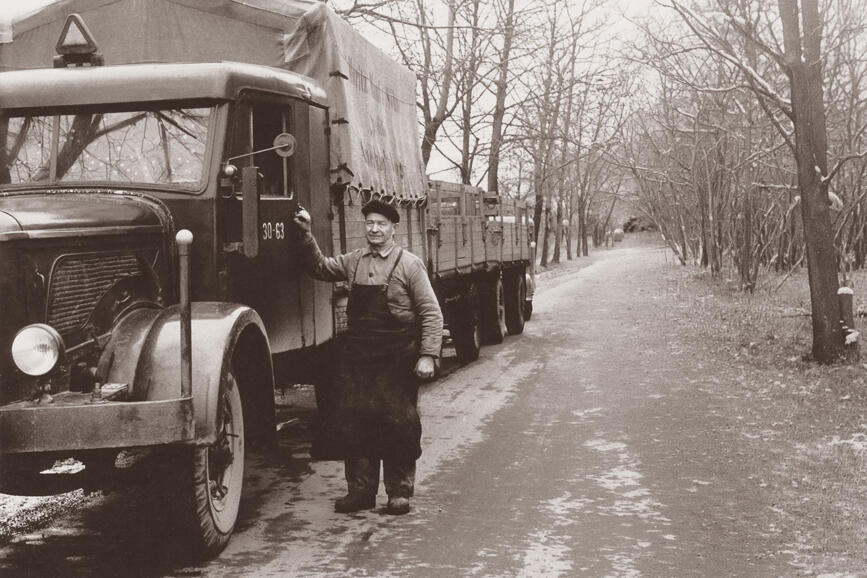
75 Years of the Framo V 901
The Little Delivery Truck on the Road to Barkas
Seventy-five years ago, production of the Framo V 901 began in Hainichen. Often described as the plant’s first new East German design, the three-quarter-ton truck mainly introduced a new engine: the three-cylinder two-stroke from the IFA F9, a design rooted in the DKW F9 developed before World War II. We trace the little Saxon truck’s history, take a look at its engine, and explain why its output was deliberately reduced. We follow the development from a van with a wood-framed body to the Barkas B 1000 and reveal what restorers find under the hood today.
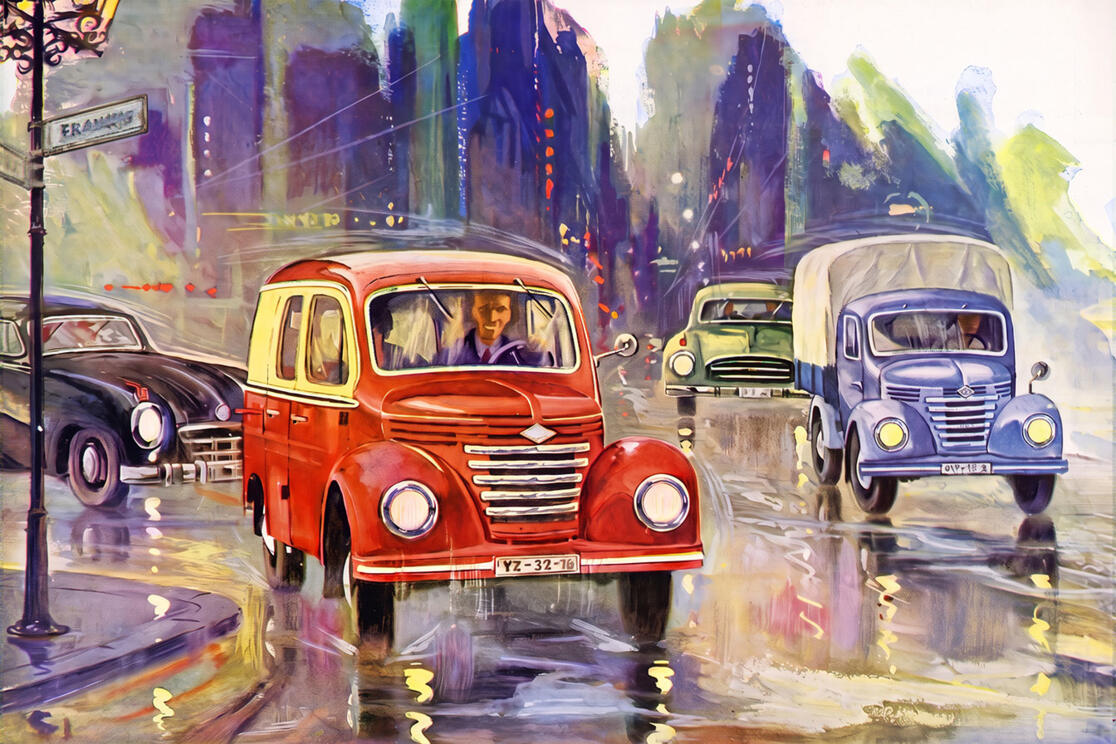
The Early Years of Metallwerke Frankenberg
This article marks the three-quarters of a century that have passed since the first V 901 was built at the Framo plant in Hainichen, Saxony. But first, we will look a little further back, because Framo’s commercial vehicle history began almost a century ago. In 1927, the first TV 300 three-wheeled delivery vehicle left the workshops of Metallwerke Frankenberg GmbH. Engineers Jørgen Skafte Rasmussen, Richard Blau, and Paul Figura had founded the company in a former barracks in 1923. Danish-born Rasmussen was also its owner. Among his many other activities, he had established Zschopauer Maschinenfabrik J. S. Rasmussen in 1912. Under the DKW brand, that business subsequently developed into one of the world’s largest motorcycle manufacturers.
The business in Frankenberg had started with 30 workers supplying motorcycle parts to the motorcycle plant in Zschopau. Building its first motor vehicle was therefore a major step forward. During development, it was initially called the DKW-Eil-Lieferwagen, or express delivery vehicle. It reached the market in 1927 as the TV 300 three-wheeler. Its air-cooled, single-cylinder DKW two-stroke engine displaced 300 cubic centimeters and produced 7 PS (metric horsepower), giving it a top speed of 40 kilometers per hour. Its payload of 500 kilograms, including the driver, was sufficient for many applications, and the little commercial vehicle quickly became popular with shopkeepers and tradespeople, even though it came without an electric starter or reverse gear. By 1928, the Frankenberg company had already sold around 1,000 three-wheelers, and its workforce gradually grew to as many as 700 employees.
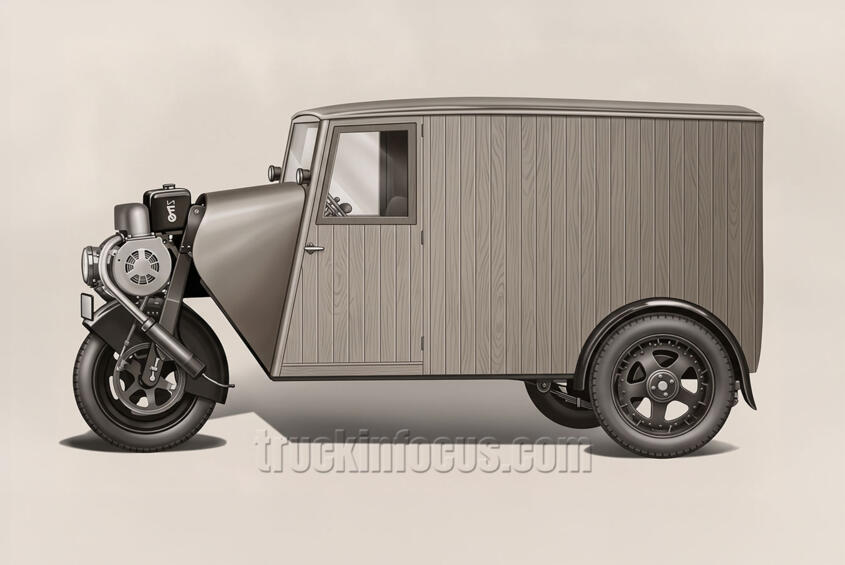
From March 16, 1928, three-wheelers with engines displacing less than 200 cubic centimeters were exempt from vehicle tax in Germany and could be driven without a driver’s license. Frankenberg therefore began developing three-wheeled variants with smaller engines. In 1930, the TV 300 was replaced by the LT 200 and LT 300. These three-wheelers still had open cabs, but now featured doors on either side. The numbers in their model designations referred to engine displacement. Passenger-carrying versions were also available at the time. Exports to many countries helped the business, including sales to India, where the three-wheelers served as motorized rickshaws. The LTH 200 and LTH 300 appeared later in 1930, now with an engine hood, an enclosed cab, a steering wheel operating a worm steering gear, and reverse gear as standard.
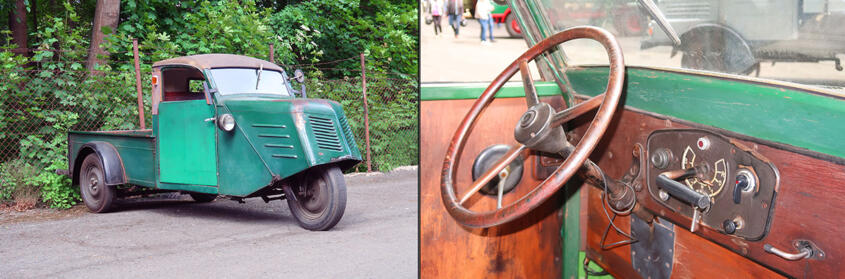
The Move to Hainichen and the Approach of War
When the former barracks in Frankenberg were earmarked for military use again, management was forced to relocate in stages from 1932 onward to a bankrupt weaving mill in neighboring Hainichen. On January 1, 1934, the company was renamed Framo-Werke G.m.b.H. Hainichen. The name referred to its original production location, Frankenberg. In the following years, thousands of Framo three- and four-wheeled vehicles traveled the roads of Germany and neighboring countries. Framo also introduced two passenger cars in 1933 and 1935: first the little front-wheel-drive Stromer FP 200, which could be driven without a license and had a single rear wheel, then the four-wheeled, rear-engined Piccolo VH 300. Combined sales of the two models totaled only 733 vehicles, however.
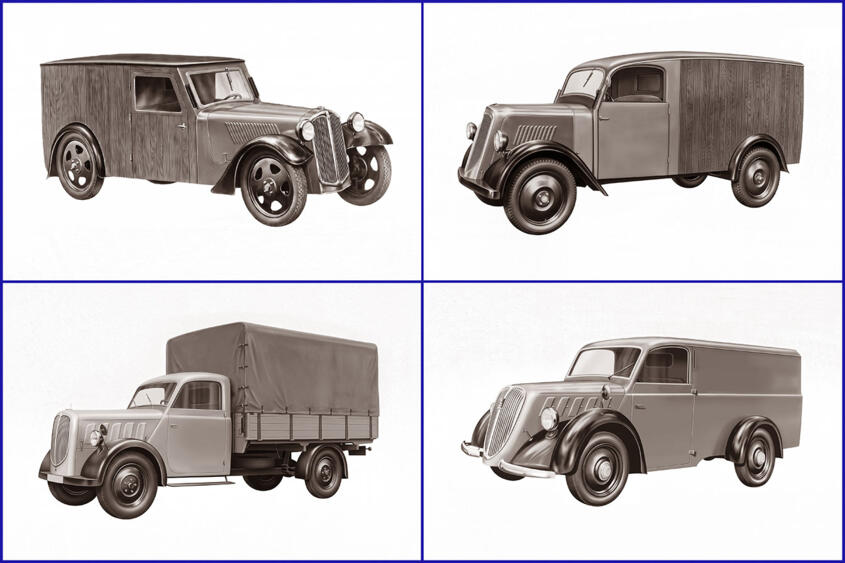
Light commercial vehicles remained the core business. Development continued on both three- and, increasingly, four-wheeled vehicles, with the front bodywork of the Stromer passenger car used on the first four-wheeled delivery model, the FPT 300, in 1934. Framo built around 3,000 vehicles a year on up to six assembly lines. Its main four-wheeled models included the FPT 300, HT 600, HT 1200, also designated V 1200, LTV 500, and V 500 ‘Typ Danzig.’ These vehicles are illustrated in this article.
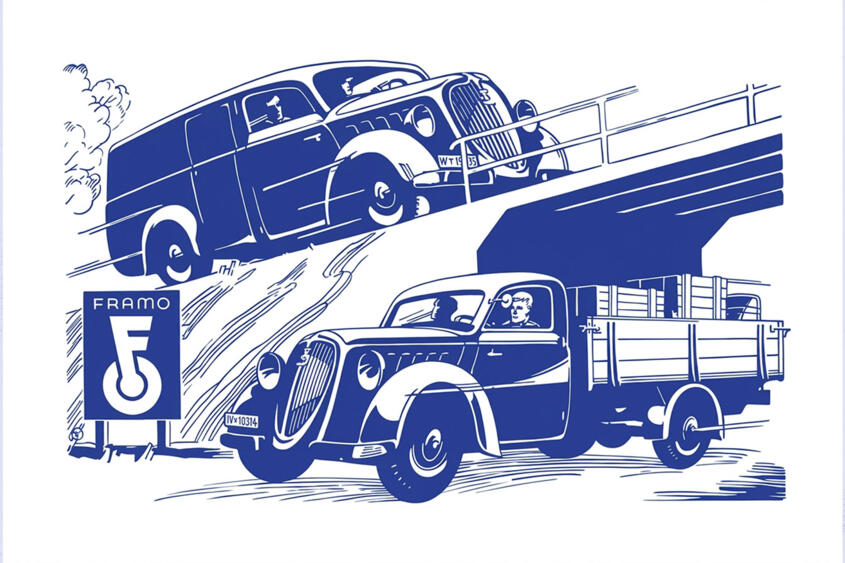
By the mid-1930s, Germany’s armaments industry was already operating at full speed. In 1939, Framo had to stop building three-wheelers because they were considered unsuitable for military use. Under the Nazi government’s Schell Plan, a decree restricted production of four-wheeled vehicles to a single model from 1941 onward, the so-called Einheitstyp 650, or standardized type. Based on the Framo V 500 of 1939, it was adapted for wartime service and simplified both mechanically and externally. The truck entered production in 1941 as the V 501. Other manufacturers, including Manderbach, Ostner, and Standard, also built vehicles to this standardized type.
Framo During World War II
In the midst of the war, Framo’s management decided to improve the engine. From 1943, the twin-cylinder DKW two-stroke was replaced by the company’s own Framo U 500, a split-single engine with four pistons, arranged in pairs sharing a combustion chamber. The engine change turned the V 501 into the V 501/2. Output rose from the previous model’s 15 PS to 17 PS. A total of 1,630 vehicles had been built by the fall of 1943, although another source gives 1,242. Production then had to switch entirely to armaments, including mortars, smoke launchers, aircraft weapons, and mechanisms for aiming guns. Framo nevertheless continued to offer conversion kits allowing both engine versions to run on propane.
The history of the Framo plant also includes its darkest chapter. On September 8, 1944, a satellite camp of Flossenbürg concentration camp was established in a former needle factory in Hainichen, about one kilometer from the Framo plant. Around 500 Jewish women, mainly from Poland and Hungary, brought from Auschwitz-Birkenau concentration camp, were forced to perform metalworking on machine guns, mortars, and smoke launchers for Framo under inhumane conditions. As the war drew to a close, evacuation of the camp began on April 14, 1945. The SS forced the women onto a death march. Traveling on foot and by train, they reached the Leitmeritz satellite camp within a week. They were subsequently taken to Theresienstadt. By present-day roads, the route from Hainichen via Leitmeritz to Theresienstadt is approximately 150 kilometers. That figure does not fully reflect the actual route the women were forced to take. The survivors were liberated in Theresienstadt by the Red Army on May 8, 1945.
Hard Times After 1945, Too
In the immediate postwar period, resuming vehicle production in Hainichen was out of the question. Although Framo’s buildings had escaped war damage, the production equipment of the former armaments factory was almost completely dismantled and shipped to the Soviet Union. Everything was packed up, with receipts duly issued by Soviet officers. A small selection gives an idea: chassis packed complete with cabs, a crate of license plates, fuel tanks, three crates of general-purpose tools, glass of every kind, wheel covers, and, from the offices, projectors, films, typewriters, and office supplies. On April 2, 1946, the factory, or what remained of it, was finally released for use again. Günther Wappler describes this in his book ‘Framo & Barkas.’
Before long, activity returned to the workshops. At first, around 50 women and men set to work making products such as kitchen stoves, handcarts, and potato mashers. Wood was plentiful, but making metal goods required ingenuity. Shell casings, for example, were cut into spiral strips to make metal tires for cart wheels and even children’s scooters. Vehicle manufacturing only gradually returned to the agenda. Alongside motor vehicle repairs, the initial manufacturing lineup included spare parts and thousands of horse-drawn carts. By 1947, the workforce had grown to 235 people.
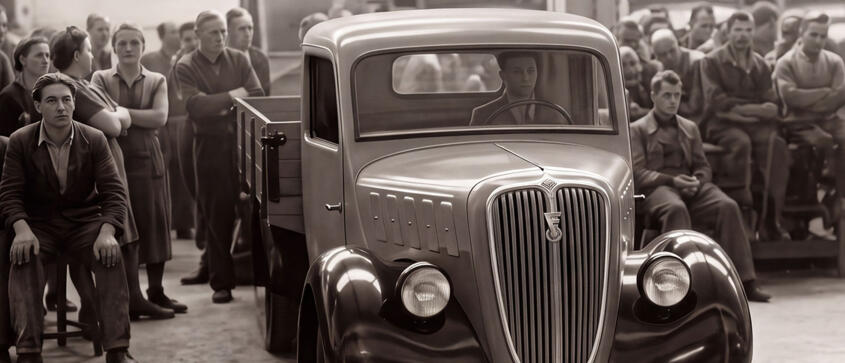
On July 1, 1949, Framo was brought into public ownership and incorporated into the Industrieverband Fahrzeugbau, or IFA. In accordance with the political requirements of the day, the company was named IFA Vereinigung Volkseigener Fahrzeugwerke – Werk Framo – Hainichen. After a six-year interruption, production of the former standardized model, the Framo V 501/2, resumed using leftover hood panels from the 1939 V 500. Once around 65 flatbed trucks had been completed, production continued with the 1943 version of the V 501/2. Around 700 light trucks were delivered in 1950. At the time, Framo employed 374 people in administration and production. Rotary tillers and motor hoes were also manufactured.
The Framo V 901 Arrived in 1951
Framo introduced the V 901 in 1951. That was the beginning of the 75-year history behind this article’s headline, since the V 901 is regarded as Framo’s first new design of the East German era. That is only half the story, however. The main innovation was the engine, as Framo had carried over the chassis and transmission largely unchanged from its predecessor. This is where the real story lies, because the engine brought technology to Hainichen that was older than East Germany itself.
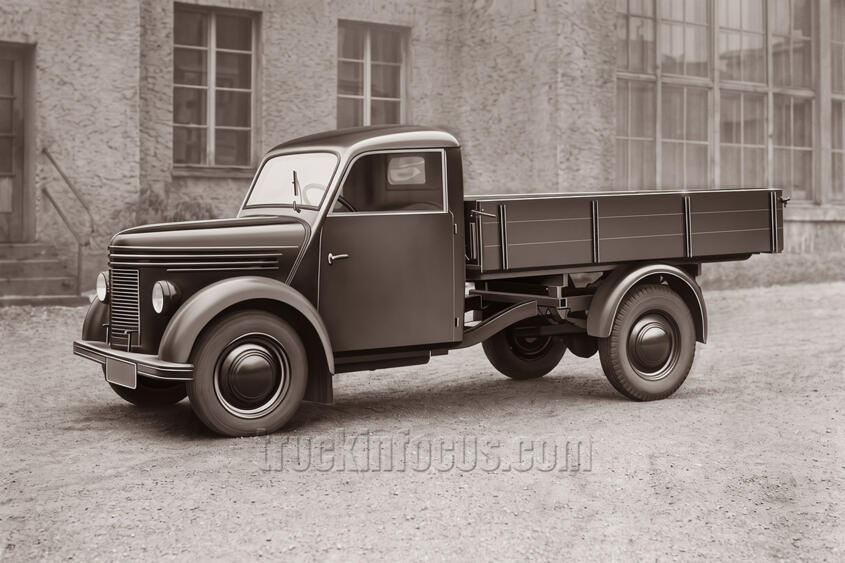
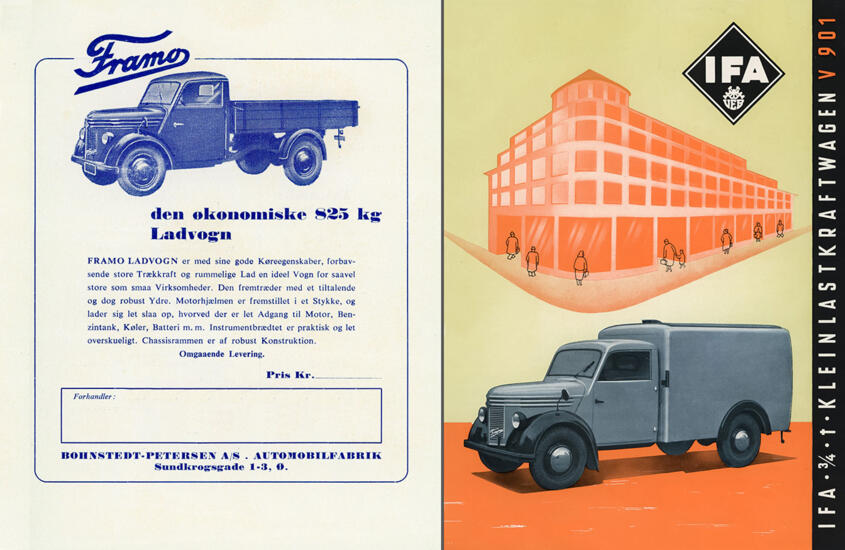
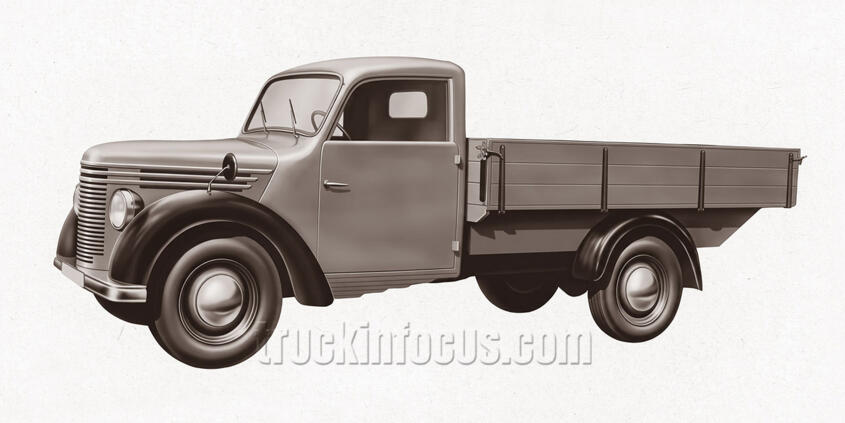
Externally, nothing had changed from the previous model, except that the V 901 came with wheel covers. It did, however, have more power, thanks to the three-cylinder two-stroke engine of the IFA F9, which was available again. The F9 passenger car was based on the DKW F9, designed shortly before World War II but never put into series production in that form. In the IFA F9, the engine initially produced 21 kW (28 PS) at 3,600 revolutions per minute. Its torque was 74 Nm at an engine speed of 2,500. In the Framo, it delivered 17.7 kW (24 PS) at the same rated engine speed and 71 Nm at an engine speed of 2,250. The sources agree on the reason for the lower output: the transmission, chassis, and brakes came from the less powerful predecessor and were not to be overloaded.
For comparison, the VW Transporter T1 introduced in March 1950 had a 1.1-liter boxer engine, displacing 1,131 cubic centimeters to be precise, producing 18 kW (25 PS) at 3,300 revolutions per minute, and a payload of around 750 kilograms. Power and payload were therefore similar to those of the Framo V 901, despite a fundamentally different design.
Supply, Demand, and Exports
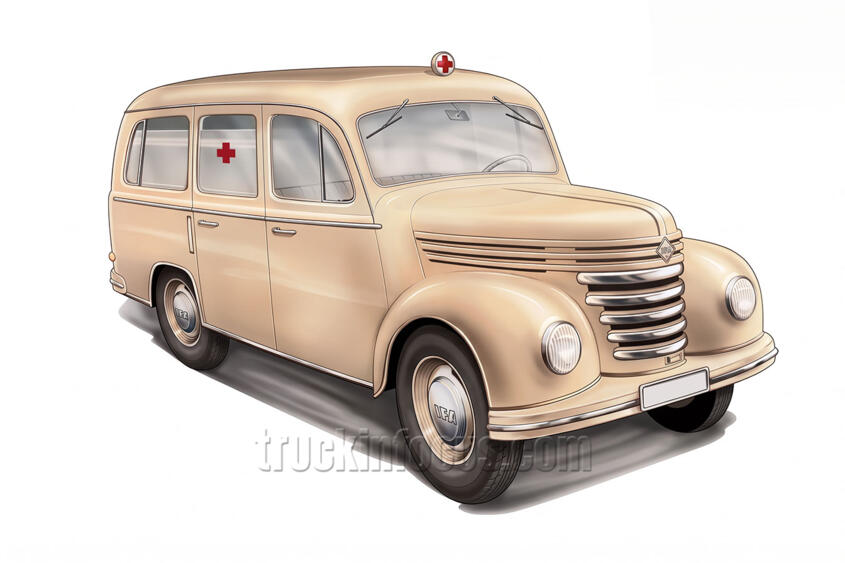
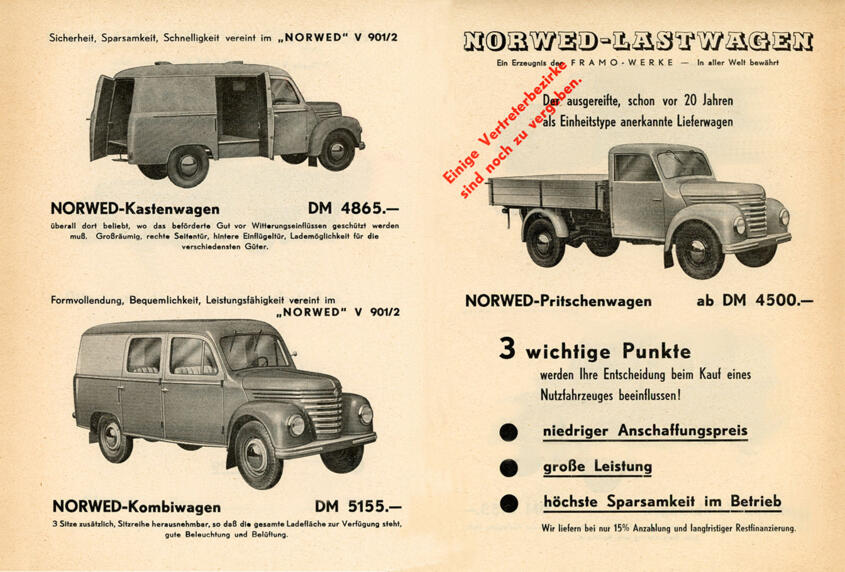
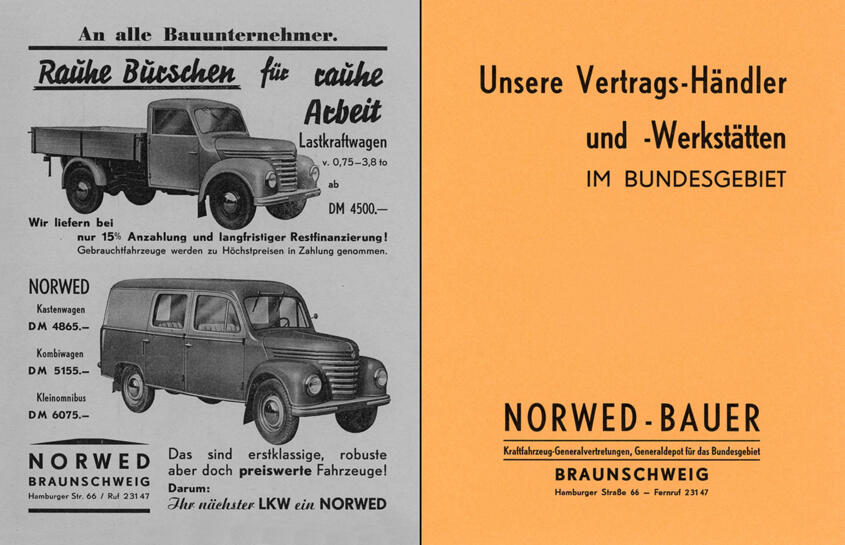
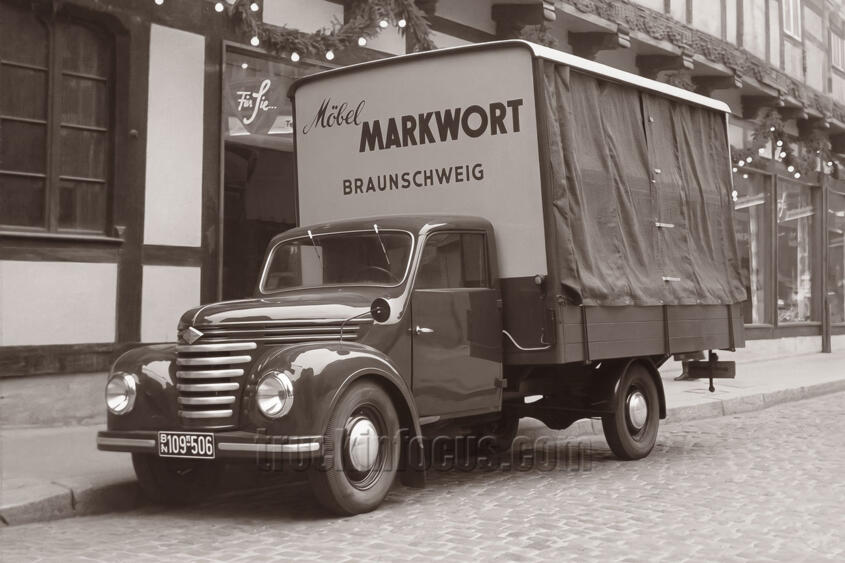
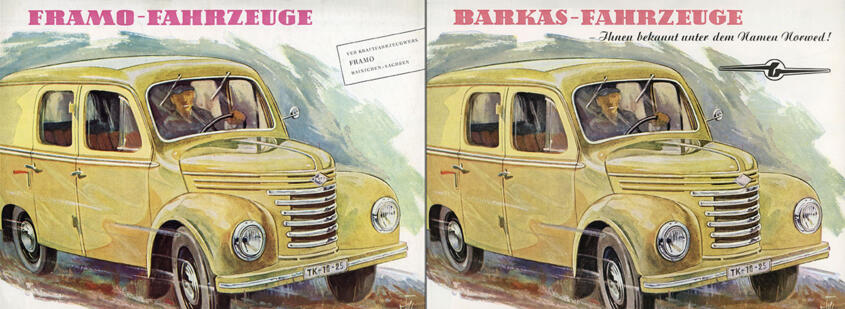
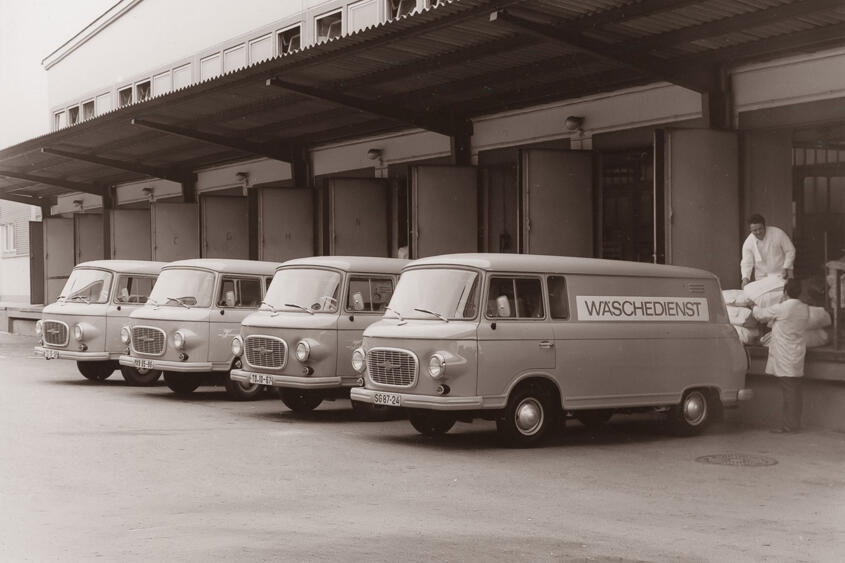
Demand far exceeded supply. In addition to flatbeds and panel vans, customers wanted ambulances, minibuses, and passenger-and-cargo versions. Specialist bodybuilders in Döbeln and Halle built the enclosed bodies, which retained traditional wooden frames covered with sheet metal. In 1952, 1,150 employees produced 1,302 vehicles. By 1954, total V 901 production had reached either 3,775 or 3,841 units, depending on the source. Either figure fell well short of domestic demand. Meanwhile, vehicles had been exported to the Netherlands and Belgium since 1951. During its production life, the V 901 was exported to further countries: Egypt, Bulgaria, Finland, Greece, Poland, Romania, Sweden, Switzerland, and Czechoslovakia. There was also a Framo dealer in Braunschweig, West Germany, who established a service network throughout the Federal Republic and marketed the vehicles under the Norwed name.
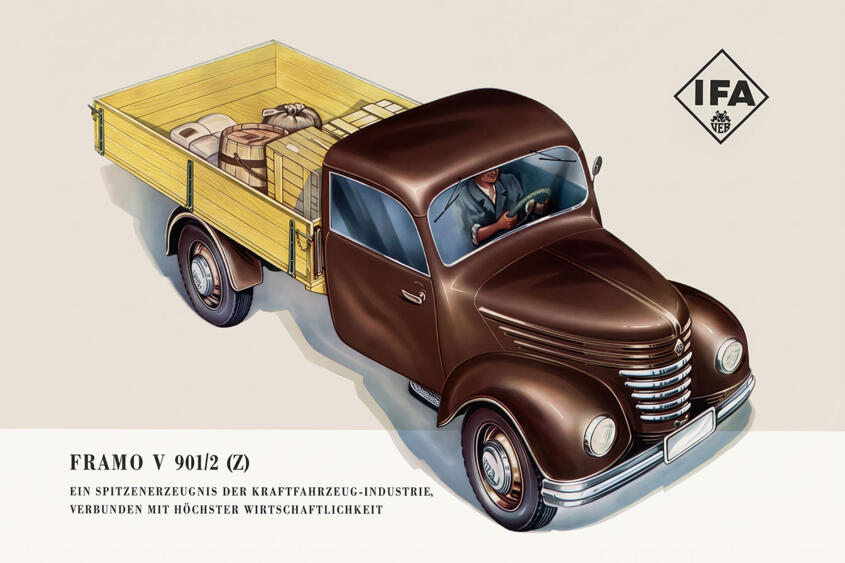
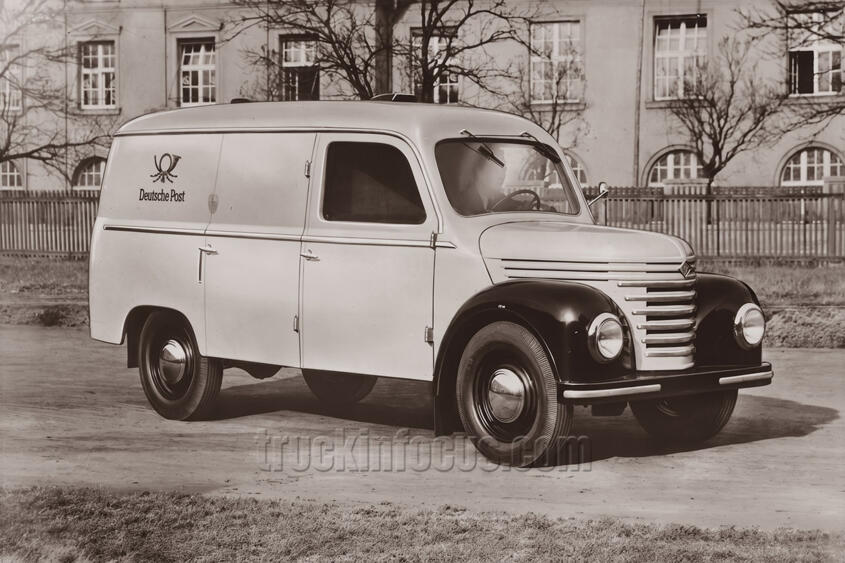
The V 901/2, introduced in 1954, was a visibly updated model. It looked distinctly different, with a wider cab, a modernized front end, and headlights integrated into the fenders. Apart from its wheelbase being ten centimeters longer, however, it differed little mechanically from the V 901. There were nevertheless improvements to the chassis and brakes, and engine output rose to 20.6 kW (28 PS). The Halle bodyworks and the Görlitz firefighting equipment plant also built special bodies for the postal service, the Red Cross, the People’s Police, and fire departments.
Framo Becomes Barkas
In 1957, the Framo brand was renamed Barkas. Management moved from Hainichen to Karl-Marx-Stadt, now once again called Chemnitz, and the Barkas plant in Hainichen became part of the state-owned VEB Barkas-Werke. The name Barkas comes from Phoenician and means ‘lightning’ or ‘the swift one.’ The Framo V 901/2 officially lost its old name, too, becoming the Barkas V 901/2. In everyday speech, however, it remained a Framo, even though the IFA emblem now appeared at the top of the radiator grille.
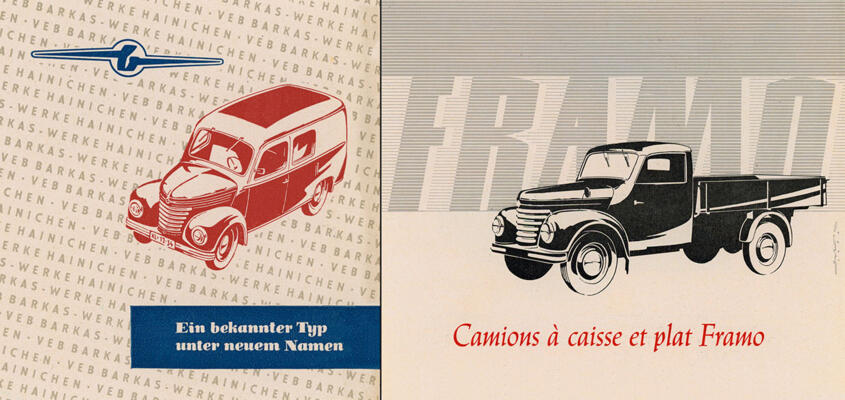
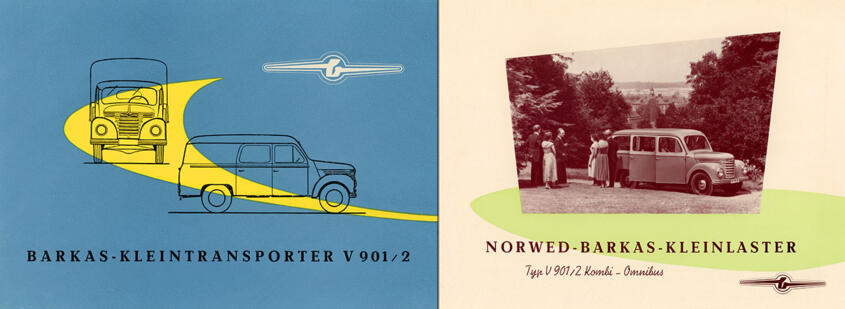
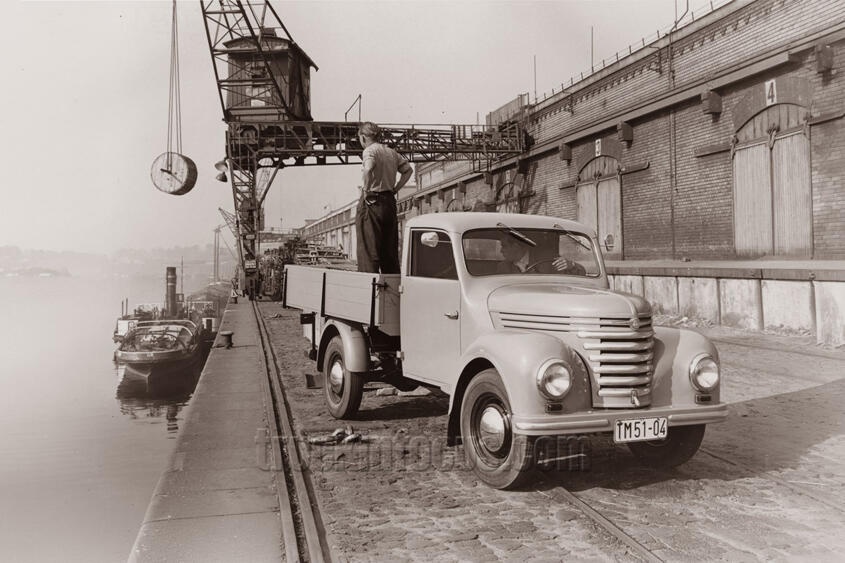
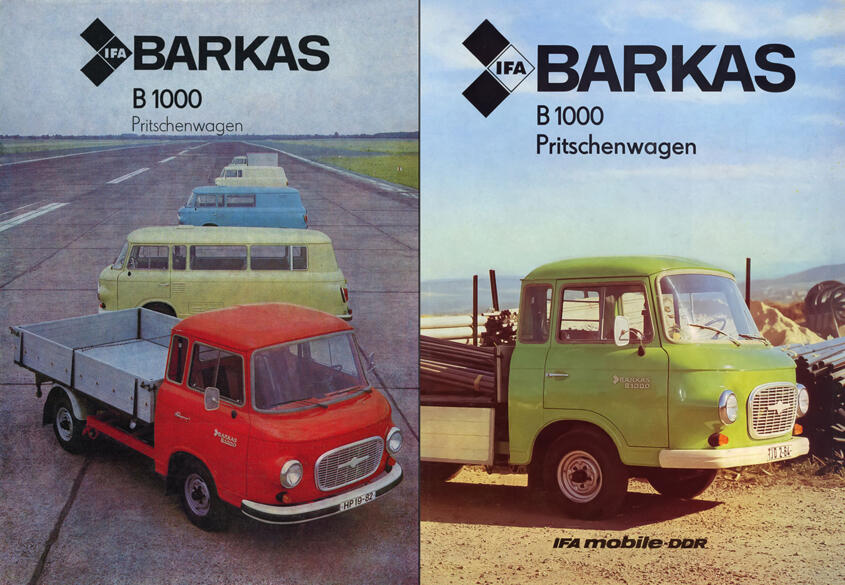
Production of the little conventional truck ended in 1961, although its overall concept had been regarded as outdated a decade earlier. In 1954, engineers and industrial designers had begun work on a new East German light commercial vehicle under the designation L1. The Barkas B 1000 was officially unveiled to the public at the Leipzig Autumn Fair in 1961, after series production had begun in Hainichen in June. B 1000 production was split between two locations. The bodies were manufactured in Karl-Marx-Stadt, while final assembly remained at the former Framo plant in Hainichen. Trucks carried the unfinished bodies the 30 kilometers between the two plants. Initially, semitrailers carried four bodies at a time. From 1965, double-deck trailers carried five.
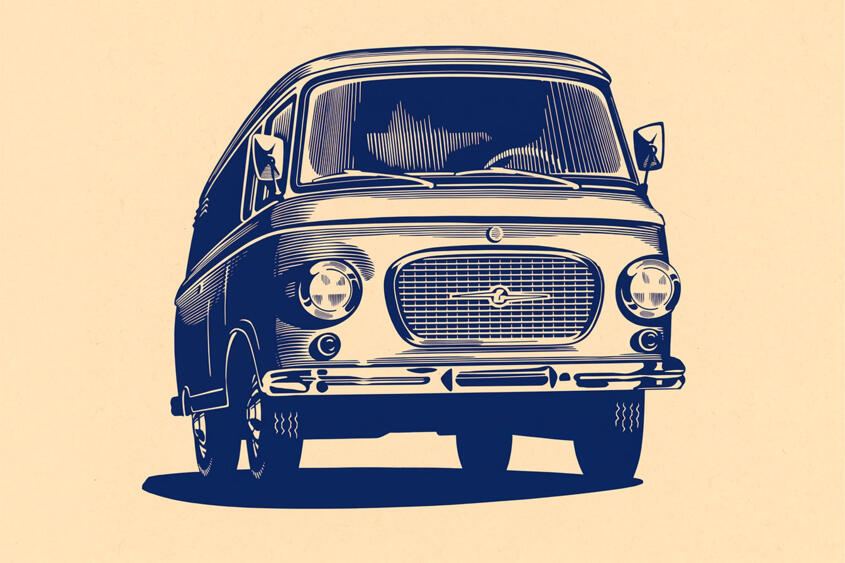
Modern and Well Proportioned: The Barkas B 1000
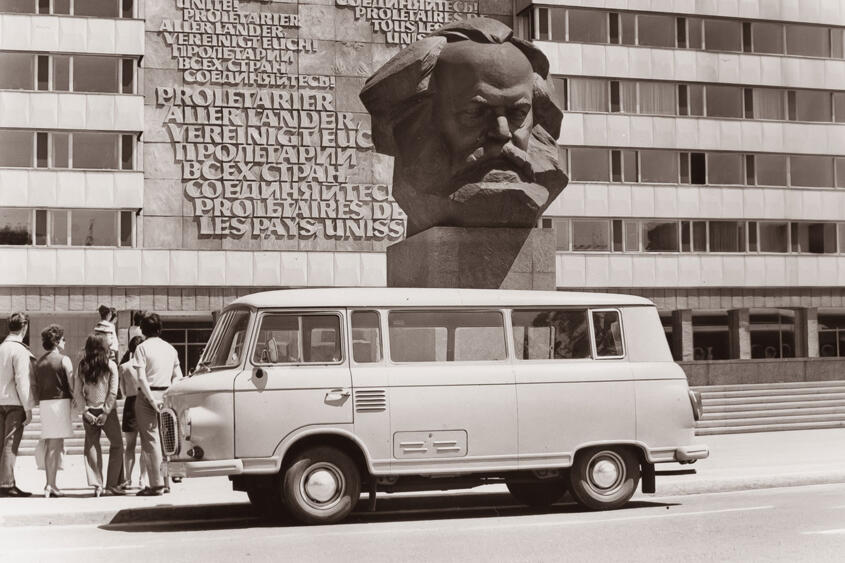
When introduced in 1961, the Barkas B 1000 was a modern design. Front-wheel drive allowed a low cargo floor, since there was no need to accommodate either a driveshaft to the rear axle or a rear-mounted engine. That made loading and unloading easier and provided a good basis for a space-efficient body. Volkswagen, by contrast, used an air-cooled rear engine in the T1, while Ford’s contemporary FK 1000, also known as the Taunus Transit, had a front engine and rear-wheel drive. Each layout had its own advantages and design limitations.
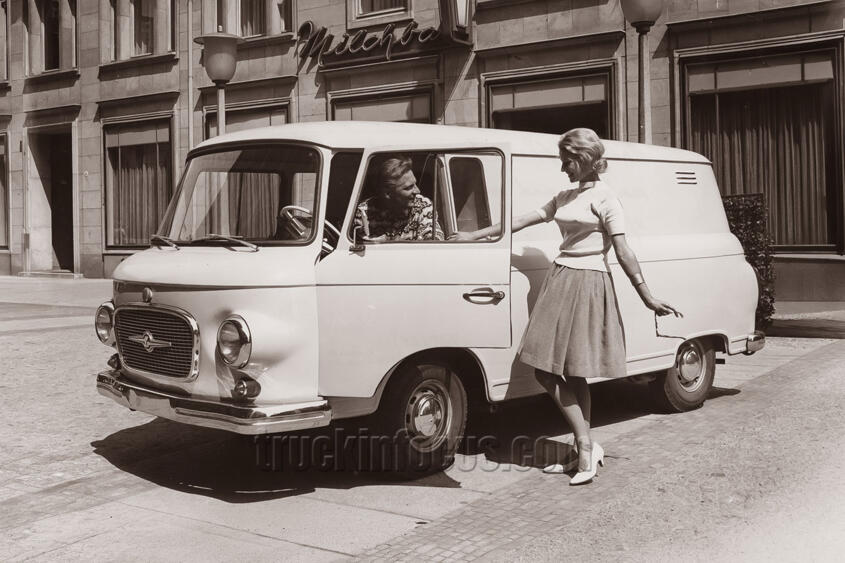
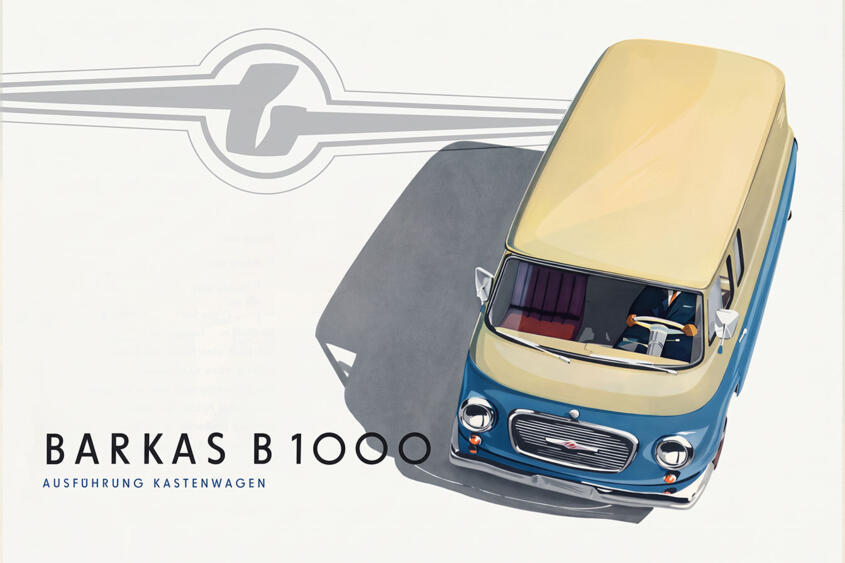
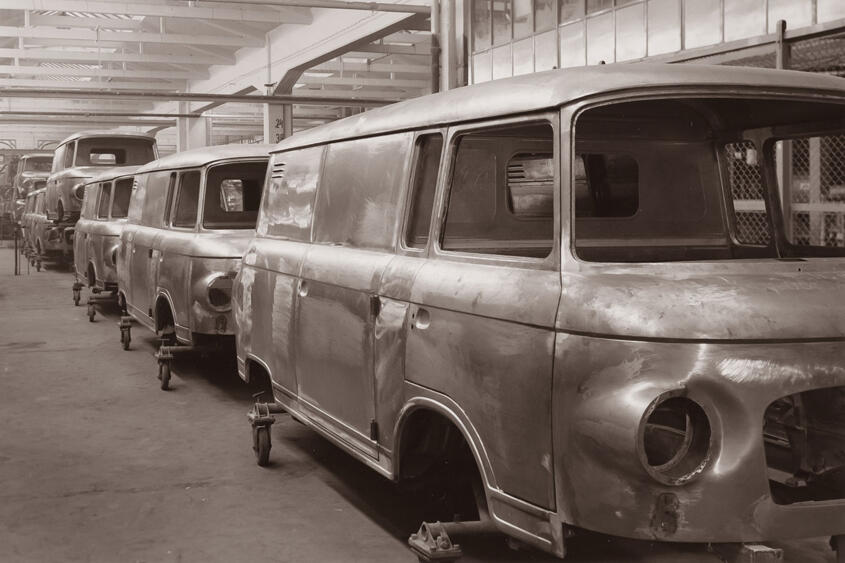
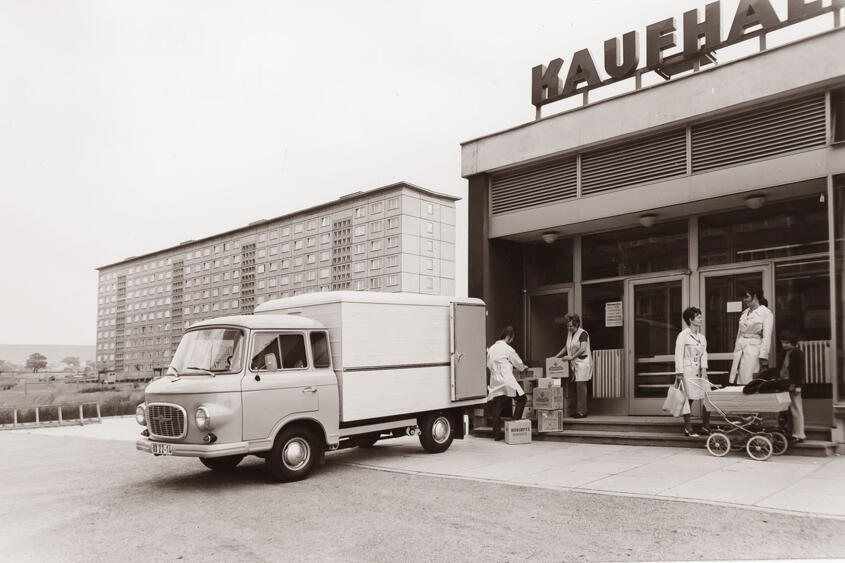
As a panel van, the Barkas offered around 6.4 cubic meters of cargo space, compared with 4.8 cubic meters in the standard VW T1. Its one-metric-ton payload was reflected in the B 1000 designation. The all-steel body was complemented by independent suspension, torsion bars, and hydraulic shock absorbers at all four wheels. These were up-to-date features, although the VW Transporter had them as well. The Barkas was particularly strong in combining compact dimensions, generous cargo space, and a low cargo floor.
Scrapped on Paper Only
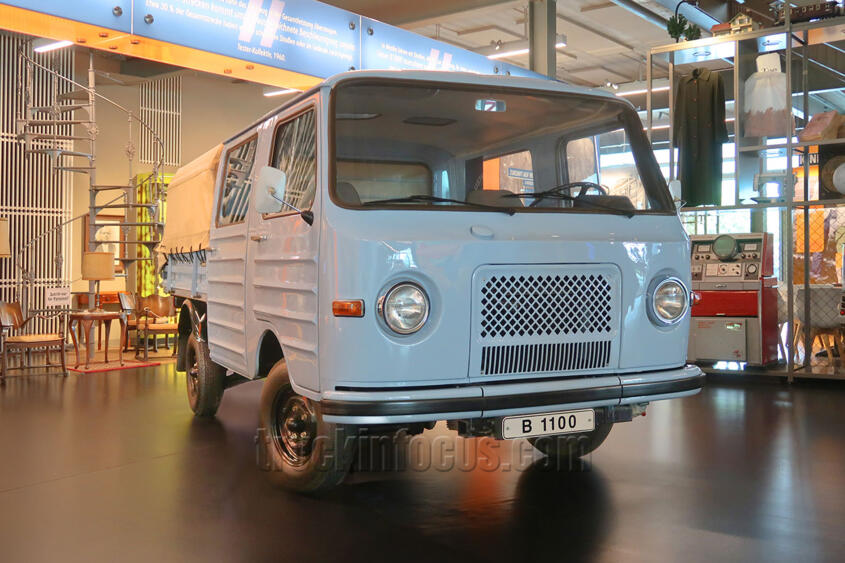
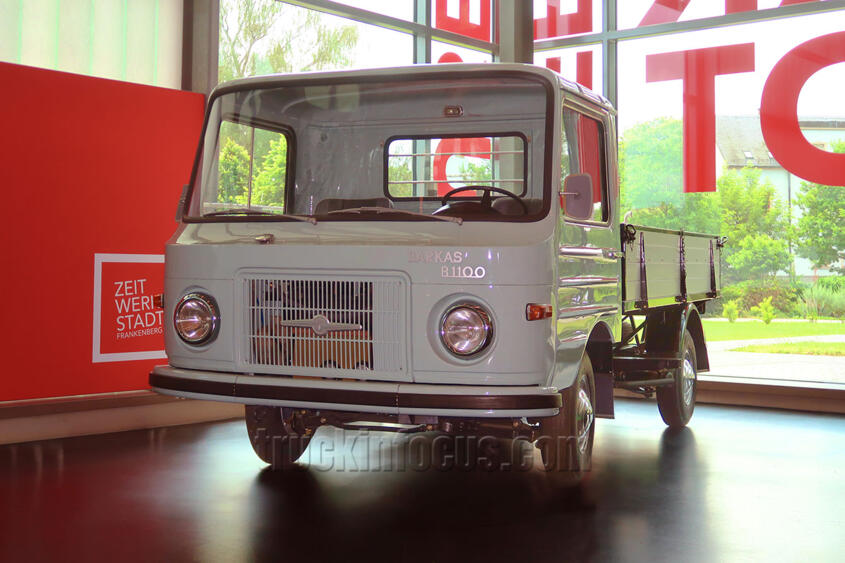
Barkas engineers were already working on a successor during the 1960s. Between 1969 and 1972, three flatbed prototypes were built under the B 1100 designation. Development goals included a four-stroke engine, increased payload, and improved brakes. The experimental vehicles used different engines, including a four-cylinder four-stroke from the Moskvich 412. In mid-1972, however, the project was halted by ministerial order. The vehicles were to be scrapped. A small group of employees saved them by hiding the prototypes, without engines or wheels, in barns around Frankenberg and certifying their destruction on paper only. We photographed two of these rare vehicles at the ZeitWerkStadt museum in Frankenberg: a flatbed with a short cab and a crew-cab version.
The B 1000 and Technical Developments in the West
Once the successor project had been abandoned, the B 1000 remained in the lineup. Its three-cylinder two-stroke engine, familiar from the Wartburg passenger car, had not in itself been an obstacle to a competitive light commercial vehicle in the early 1960s. The limitations became increasingly evident over its long production life, however. While Volkswagen and Ford developed new generations of their vans and offered a wider selection of engines, the Barkas retained its small two-stroke. The engine’s simple construction was increasingly offset by an unfavorable balance between power and fuel consumption. Added to that were its characteristic engine noise and the exhaust emissions produced by burning a gasoline-oil mixture.
VW and Ford were already using four-stroke gasoline engines at that time. Diesel engines broadened their offerings as development continued. The first diesel in the VW Transporter appeared in the T3 in 1981. Barkas did not present the B 1000-1 with a 1.3-liter four-stroke engine manufactured under license from VW until the fall of 1989. Series production followed in 1990. The new engine improved the vehicle’s prospects, but could not comprehensively modernize a basic design that was now almost three decades old. After the political changes in East Germany, the van faced a considerably larger selection of competing vehicles.
The Barkas B 1000’s body design, by contrast, has retained its appeal to this day. With its harmonious, perfectly proportioned curves, it is a fine example of vehicle styling in the tradition of the 1950s and 1960s. Unfortunately, by the time this article went to press, we had been unable to establish who, or which design office, was responsible for the B 1000’s body. We would nevertheless like to give its designers full credit.
Framo Survivors Out of Sight
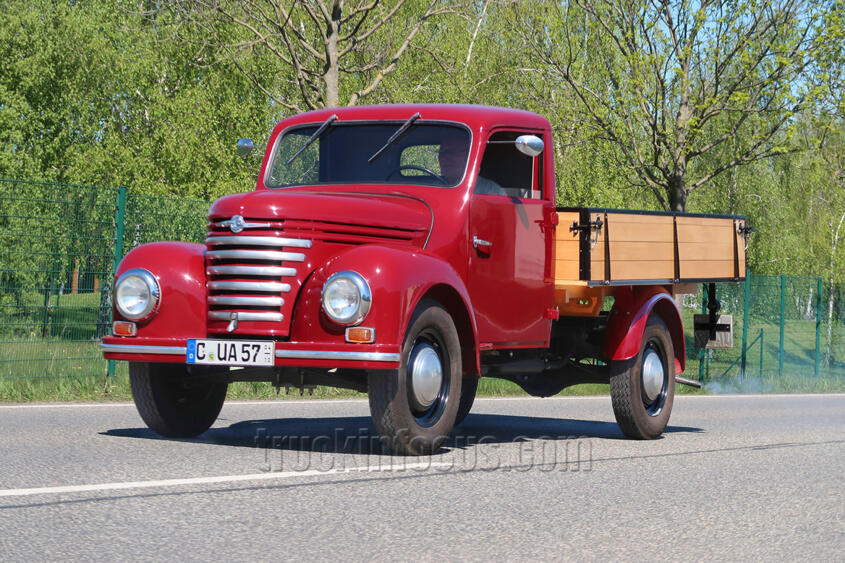
As East Germany approached its end after 40 years, many examples of the little conventional-cab trucks from Hainichen were still on the road, mainly handling internal transport for state-owned enterprises or working for tradespeople. After the political changes, they gradually disappeared from view. Yet many of the Framo veterans now seen at commercial vehicle gatherings spent years or even decades hidden away, as dedicated Framo restorer Oliver Trebes recounts on his website. The original two-stroke engines displacing 900 cubic centimeters now survive in only a few classic vehicles. Many now run Wartburg engines displacing 1,000 cubic centimeters and producing between 33 kW (45 PS) and 37 kW (50 PS). This raises a fundamental question for restorers: return to the original engine, or preserve a conversion that makes the vehicle more usable and has itself become part of its history? Each owner must find their own answer.
Visitor Information
The particularly imaginative ZeitWerkStadt experience museum in Frankenberg, the town where Rasmussen founded Metallwerke in 1923, has displayed a collection of Framo and Barkas vehicles from every generation since 2021. Its standout exhibits come from the former Frankenberg vehicle museum.
Owners of Framo and Barkas vehicles gather annually at Framo/Barkas meetings in both Frankenberg and Hainichen. The next events are scheduled for June 5, 2027, in Hainichen and June 11–13, 2027, in Frankenberg. The large classic vehicle gathering held in Hartmannsdorf each year on May 1 also regularly attracts many vehicles from both brands.
Text: Steve St.Schmidt · Images: Edition Diesel Queen archive
Sources:
40 Jahre VEB Barkas-Werke, Günther Fuchs, 1967, published by VEB Barkas-Werke
Fahrzeuglexikon Framo/Barkas, Jürgen Lisse, 2008, Bildverlag Böttger, ISBN: 978-3-937496-23-8
Framo & Barkas, Günther Wappler, 2005, WMS-Werbung, ISBN: 3-931770-63-X
Framo – Model Overview
Flossenbürg Concentration Camp Memorial – Hainichen Satellite Camp
Tobias U. Müller – ZeitWerkStadt and the B 1100 Prototypes
Frequently Asked Questions About Framo and Barkas
Framo and Barkas are successive brand names within the same Saxon truck-building tradition. In 1957, Framo became Barkas. The V 901/2 being built at the time was therefore offered first as a Framo and later as a Barkas. Not every Barkas is a B 1000. It was not until 1961 that the Barkas B 1000 introduced a fundamentally new vehicle design.
The most obvious distinction is the headlights. On the V 901, they stand separately alongside the hood. On the V 901/2, built from 1954 onward, they are integrated into the fenders. The later model also has a wider cab and a modernized front end. On vehicles restored or modified during their working lives, however, appearance alone does not always allow a reliable identification. The manufacturer’s plate and vehicle documents can then help.
The three-cylinder two-stroke produced 28 PS in the early IFA F9, but 24 PS in the Framo V 901. The truck carried over the transmission, chassis, and brakes largely unchanged from its less powerful predecessor. Reducing engine output was intended to prevent these components from being overloaded. Even so, 24 PS was a significant improvement over the previous Framo engine’s 17 PS.
Front-wheel drive eliminated the need for a driveshaft to the rear axle. Nor was there a rear-mounted engine taking up space in the back of the body. That made it easier to provide a low cargo floor and a large load compartment. As a panel van, the B 1000 offered around 6.4 cubic meters of cargo capacity and a one-metric-ton payload. The low loading height was particularly useful on delivery rounds with frequent loading and unloading.
Yes. The Barkas B 1000-1 was presented in the fall of 1989, with series production beginning in 1990. It used a 1.3-liter four-cylinder four-stroke engine manufactured by Barkas under license from VW. This distinguishes the final production version from the familiar B 1000 with its three-cylinder two-stroke. The new engine extended vehicle production only briefly, however. Truck manufacturing ended in April 1991.