The Borgward chronicle with Hansa-Lloyd from 1931, Goliath, and Lloyd
Page 7
By Christoph Büch and Steve St.Schmidt (2026)
Lloyd in the 1950s
In February 1949, Carl F. W. Borgward founded Lloyd Maschinenfabrik GmbH, which shortly thereafter began operations on the premises of the Goliath Works in Bremen-Hastedt. Borgward provided half of the share capital of DM 100,000 himself, with his wife and an engineer friend helping with the rest. The young company initially produced EL 3000 electric vehicles based on the Borgward B 3000 from the Second World War. The British occupying forces were the customers. Since Borgward had concluded a three-year maintenance contract with the British for a lump sum and the vehicles hardly needed any repairs, the business was very profitable.
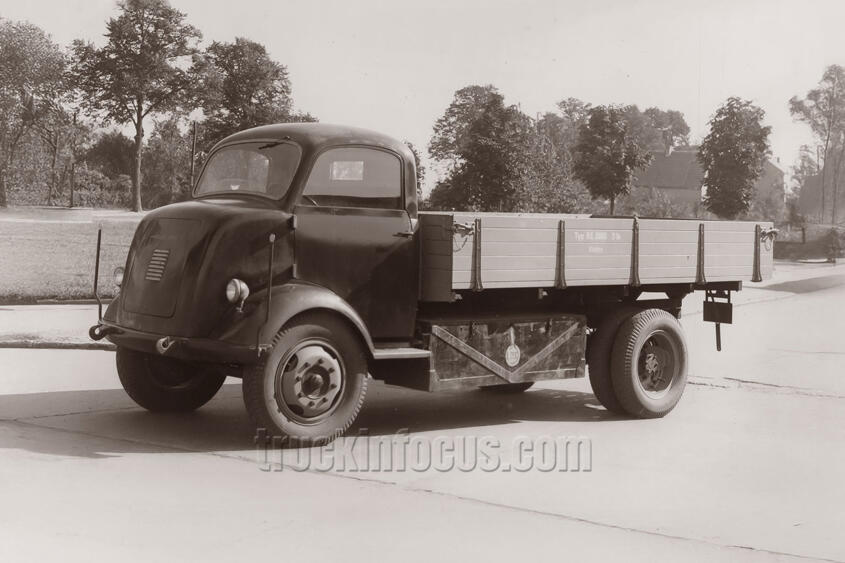
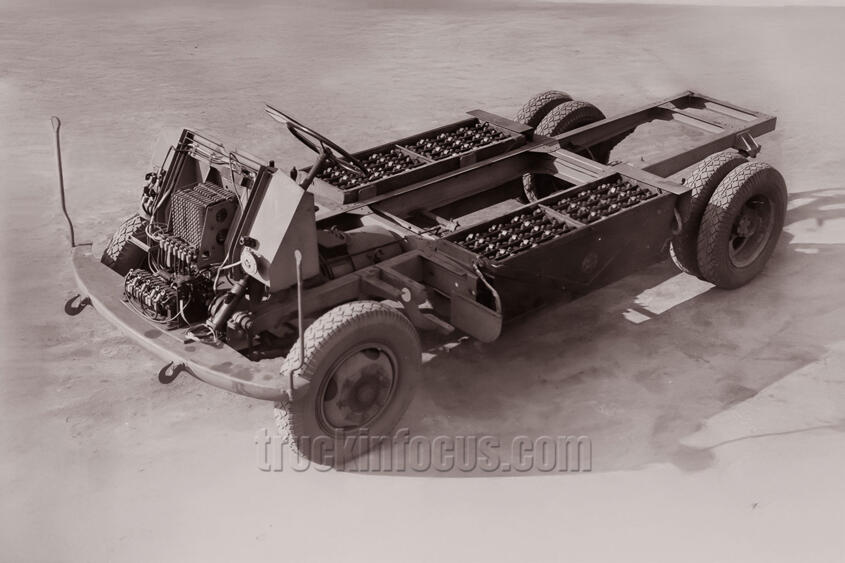
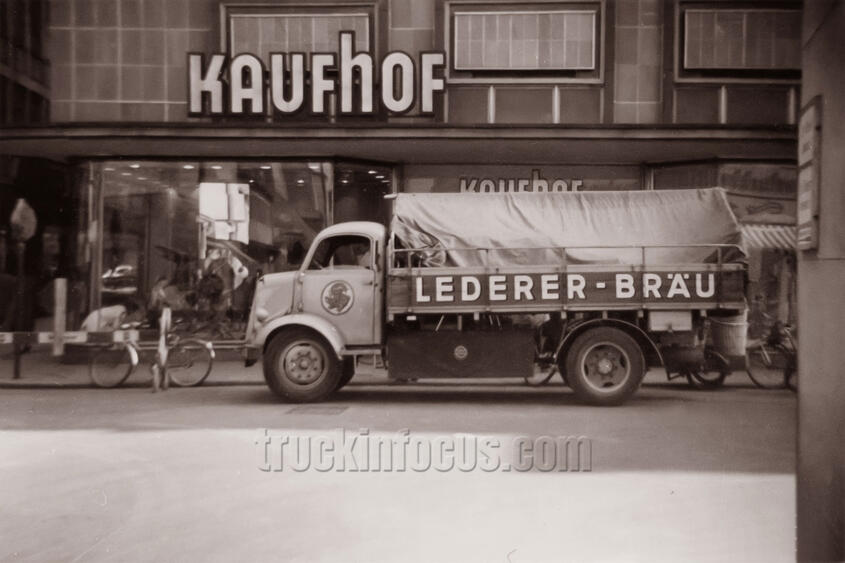
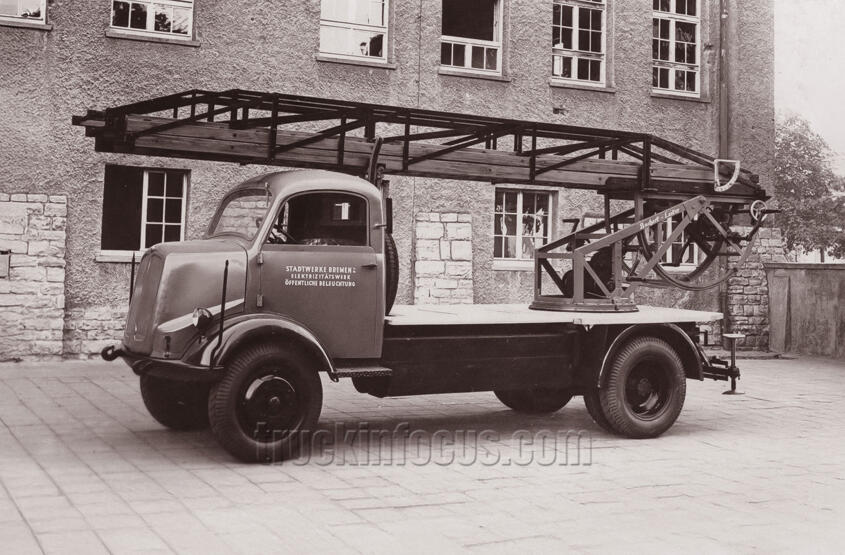
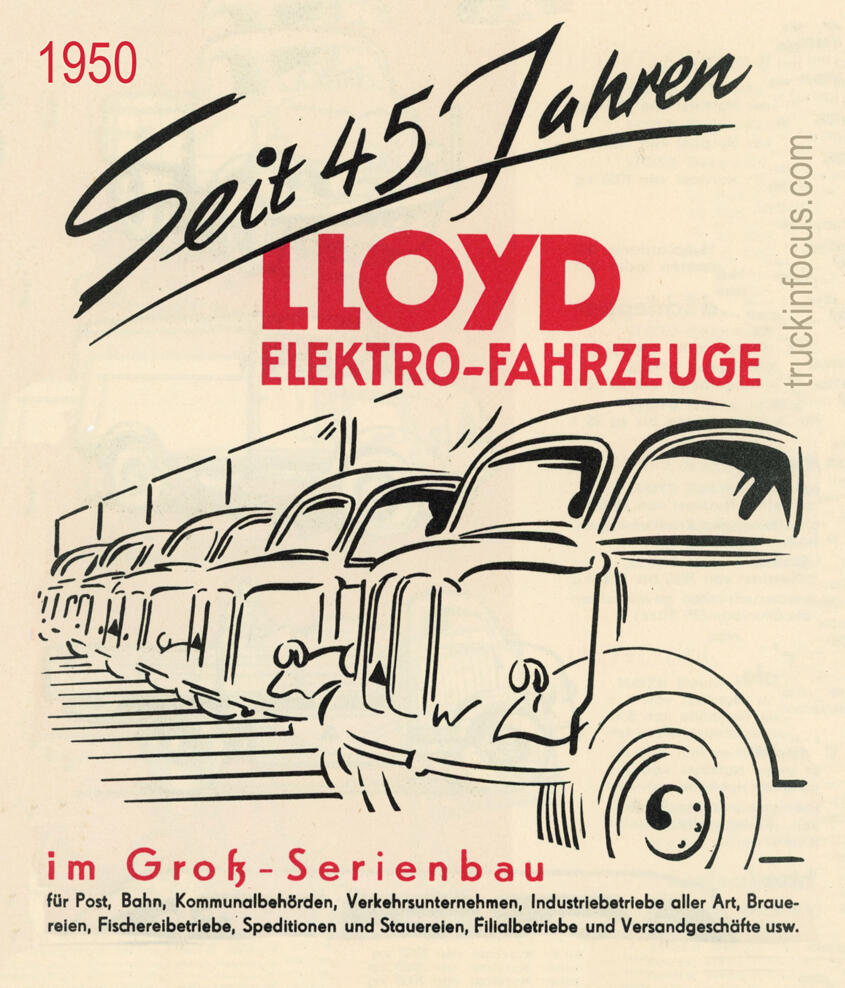
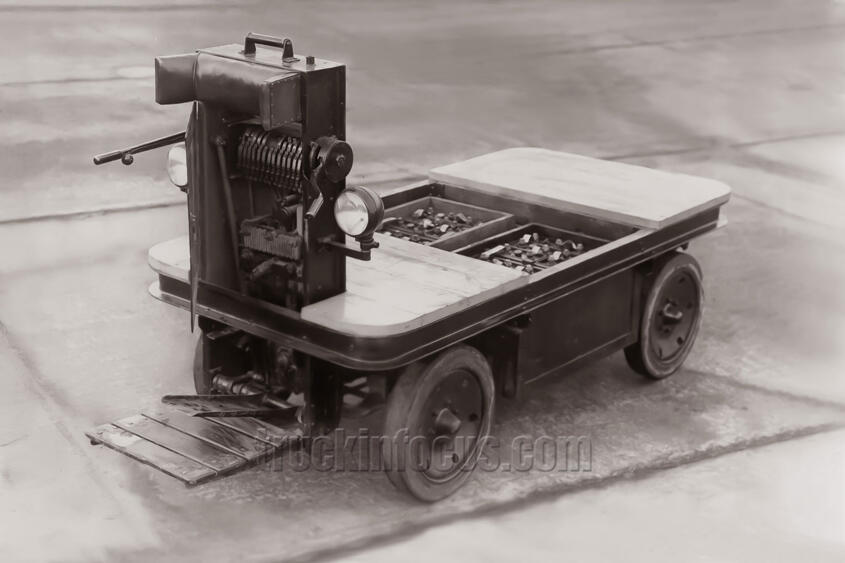
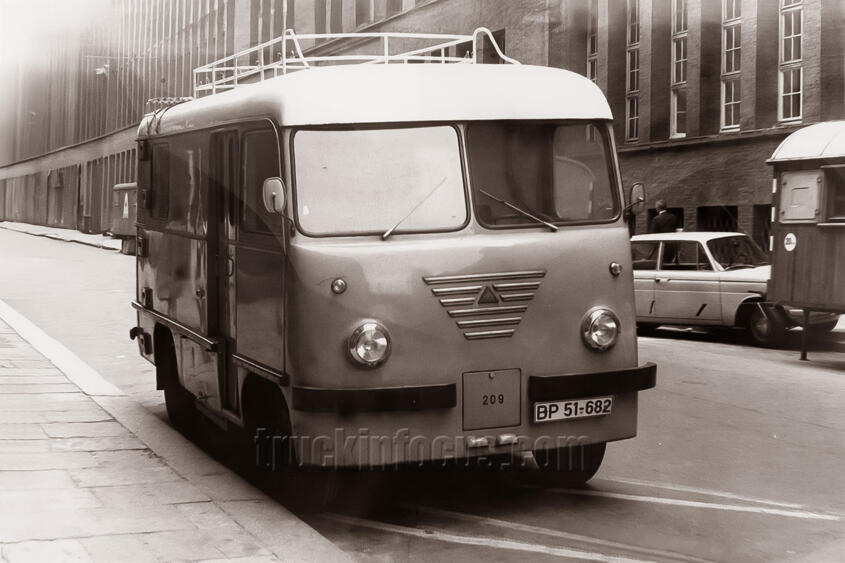
First, we will introduce the Lloyd electric vehicles of the post-war period, starting with the EL 3000 model. It was offered as the Borgward BE 3000 electric car until Carl F. W. Borgward founded Lloyd Maschinenfabrik GmbH in February 1949. The electric vehicle version, based on the B 3000 with a combustion engine, was a reliable truck that was particularly popular with breweries. With a range of around 70 kilometers on fully charged batteries, the Lloyd EL 3000 was an ideal local delivery vehicle.A look at the chassis of the EL 3000 reveals the drive unit located at the front. The heavy batteries were housed in two containers in the center of the vehicle, which were attached to the right and left sides of the chassis to ensure even weight distribution.A Lloyd El 3000 that was used by the Lederer Brewery, founded in Nuremberg in 1814. The brewery was abandoned in the 1990s, but Lederer beers are still produced regionally by the Tucher Brewery today.The 17-meter turntable ladder superstructure of this Lloyd EL 3000 came from the Bachert brothers' firefighting equipment factory in Bad Friedrichshall-Kochendorf, founded around 1830, which went bankrupt in 1987. The vehicle pictured was used by the Bremen public utility company to carry out repairs to public lighting for the power plant. The photo is dated 1952.In 1950, Borgward advertised his company, Lloyd Maschinenfabrik GmbH, with 45 years of experience in the construction of electric vehicles. This referred to the products of Hansa-Lloyd, which had indeed been focusing on electric vehicles since its foundation in 1914. However, NAMAG had already begun manufacturing electric vehicles in 1908 (NAMAG merged with Hansa in 1914 to form Hansa-Lloyd). So the 1950 advertising slogan had a certain degree of truth to it.Lloyd also produced various electric carts that were used at train stations, airports, and in internal company areas. The picture shows the EK 1500, which was marketed from 1948 to 1952, first by Borgward itself and then as Lloyd. For the photo, some covers were removed to reveal the technology.We have already presented the Lloyd EL 2500 in this Borgward chronicle on page 5 (Borgward after 1945). Here is another photo of an EL 2500 parcel van with a slightly modified front end. This is probably due to the body manufacturer, because although the postal service had precise specifications for the construction of these vehicles, there were still small differences. This is because, in addition to the main supplier Nordwestdeutscher Fahrzeugbau (NWF), other companies were also commissioned to build these postal vehicles.
In May 1950, the LP 300 small car was launched with the traditional Lloyd name. Due to the material shortages at the time, its body consisted of a wooden frame with plywood planking and a plastic coating. This quickly earned it the nickname “Leukoplastbomber” (band aid bomber). Somewhat more malicious was the saying “Those who are not afraid of death drive a Lloyd.” A two-stroke, two-cylinder engine with a displacement of 300 cubic centimeters and 10 hp powered the small front-wheel-drive car. There were also station wagon and delivery van versions.
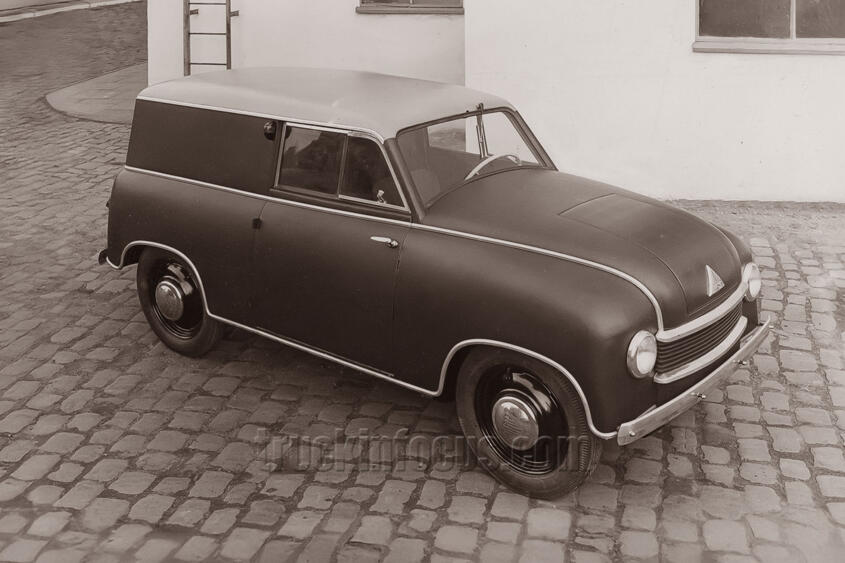
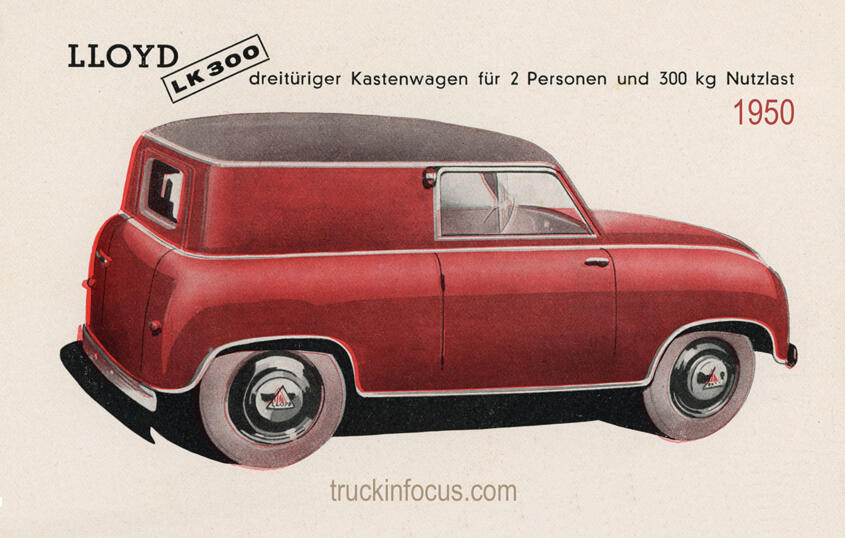
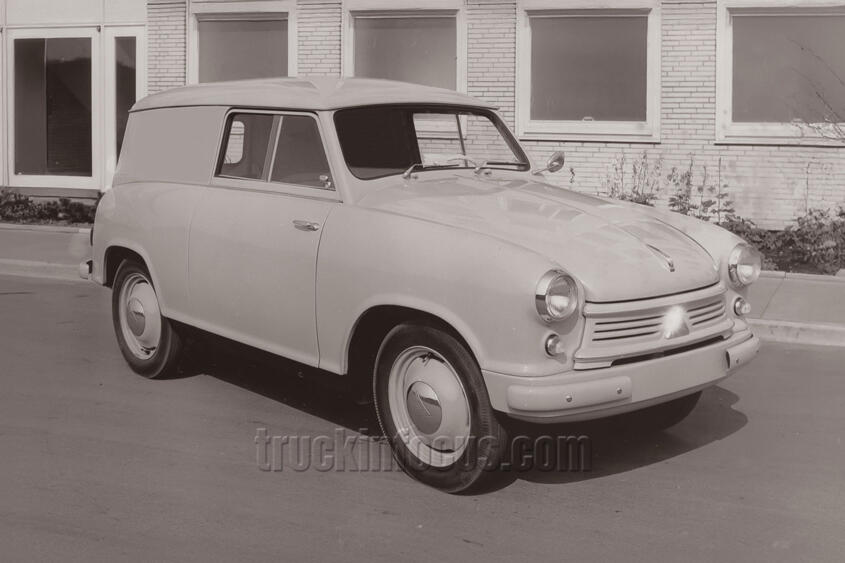
We now come to the better-known commercial vehicles from Lloyd, starting with the LK 300 panel van from 1950, which was produced for two years. The small delivery van with a payload of 0.3 tons had a wooden body covered with imitation leather. This earned it the nickname “Leukoplastbomber” (band aid bomber). The jokes made about it did not harm its popularity, as the Lloyd 300 with its 10 hp engine sold well both as a passenger car and as a delivery van. The successor model, the Lloyd LK 400 from 1953, had a two-stroke engine with 13 hp. In 1957, the series was discontinued.A page from a 1950 Lloyd brochure advertising the LK 300The 1955 Lloyd 600 can be considered the successor to the LK 400, which was offered from 1953 to 1957. From the outset, its body was made of sheet steel and it was equipped with a 19 hp four-stroke engine with a displacement of 600 cubic centimeters, which gave it a top speed of 100 kilometers per hour. The delivery van version was relatively rare, but it sold well as a passenger car until the collapse of the Borgward Group in 1961 sealed the end of Lloyd production.
At the beginning of 1951, the company was renamed Lloyd Motorenwerke GmbH. Shortly thereafter, it moved to a new factory on a 200,000-square-meter site in Bremen-Neustadt. The factory facilities there grew steadily until 1960.
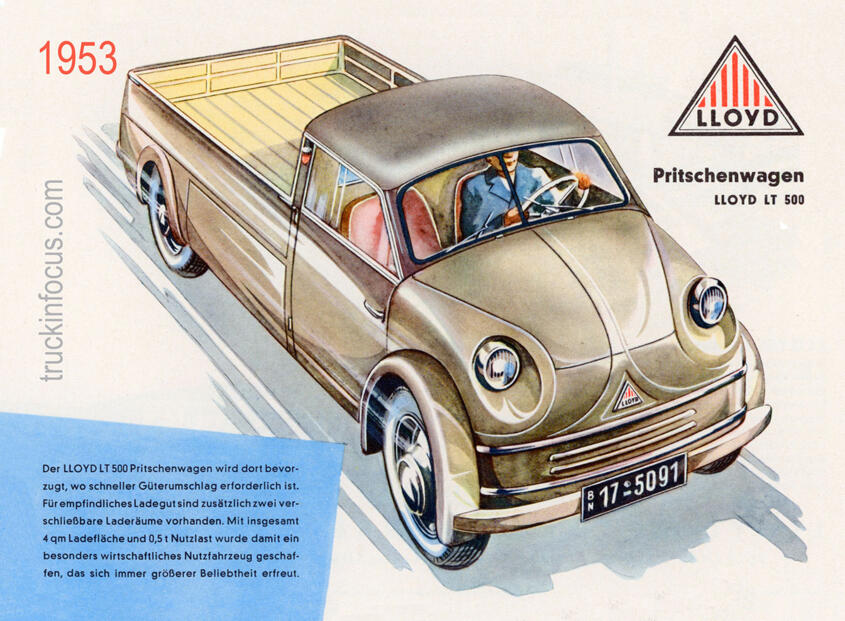
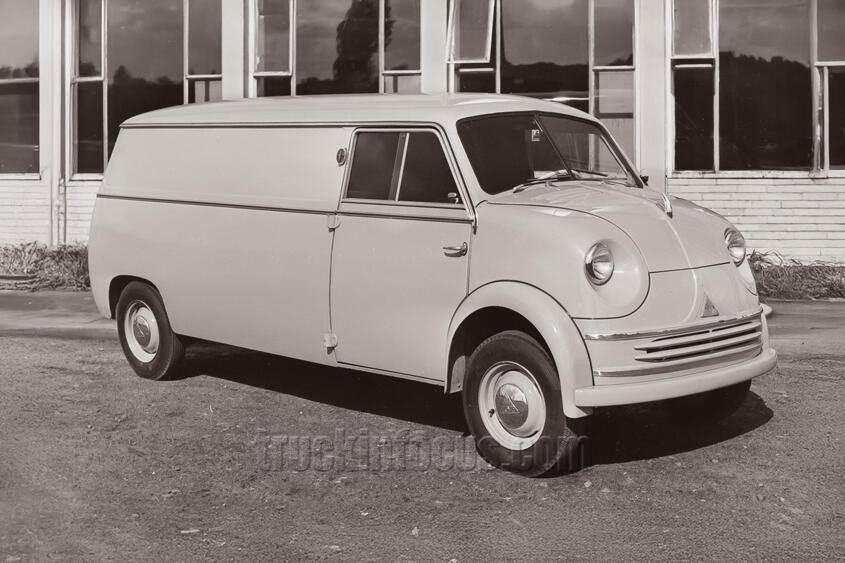
Over the years, other passenger cars followed. At the end of 1952, Lloyd introduced the LTK 500, a panel van for small businesses. It had a half-ton payload and the plywood body typical of Lloyd. It was also available as a six-seater minibus (LT 500/6). In 1953, the LT 500 pickup was added. After the two-stroke engine was converted to a four-stroke engine in September 1955, the car was renamed LT 600. From the end of 1956, the panel van and minibus were also available with the pickup's chassis extended by fifty centimeters. The long version of the LT 600/6 was also exported to the USA, where it was used in considerable numbers, primarily as a camper.
A page from a 1953 brochure advertising the LT 500The body of the LT 500 was also initially made of plastic-coated wood in 1952. From 1954 onwards, the car was gradually developed into a metal vehicle: first the side panels, then the hood, and finally, in 1957, the roof were made of sheet steel. The LT 500, which was initially underpowered with a 13 hp two-stroke engine, was given a more powerful 19 hp engine in 1955 and was renamed the LT 600. The photo from 1957 shows the last version, which remained on sale until 1961.