Italian buses of the 1950s and 1960s – Part 1

Nothing seemed impossible – bodywork construction in an era of creativity

The variety of designs in automotive engineering after World War II fascinates many classic car enthusiasts. Also, commercial vehicle construction, especially buses, clearly demonstrates the imagination, style, and craftsmanship that went into bodywork in the 1950s. Southern Europe, in particular, spared no effort to perfect bus bodywork at the time. In this article, we present Italian bus designs that have a harmonious appearance that is hard to beat. It's no surprise that Italian body designers are among the most renowned in the world.
It goes without saying that Truckinfocus.com is all about trucks. But excursions into the automotive neighborhood must be allowed. That's why we've once again put together an article about buses, turning our attention to Italy. There, the bodies were manufactured almost exclusively by external bodywork companies, as the major commercial vehicle manufacturers Alfa Romeo, Fiat, Lancia, and OM limited themselves to supplying chassis with engines. The task of turning these into technically and visually sophisticated buses fell to the body builders.

In this article, we showcase a few city buses and coaches from Italy that were in use during the 1950s and 1960s. It is noteworthy that Italy switched to cabover construction earlier than other countries. Italy's topography, with its narrow, winding roads, likely led to the realization that shorter buses are easier to maneuver. Many buses were right-hand drive for safety purposes at the time. Drivers had a clear view of the right-hand side of the road, and overtaking maneuvers were rarely necessary on Italy's roads.

As a kind of foreword, our article begins with two photos from the pre-war period that we came across while compiling material in our archive. We found these photos so remarkable that we wanted to share them with our readers.

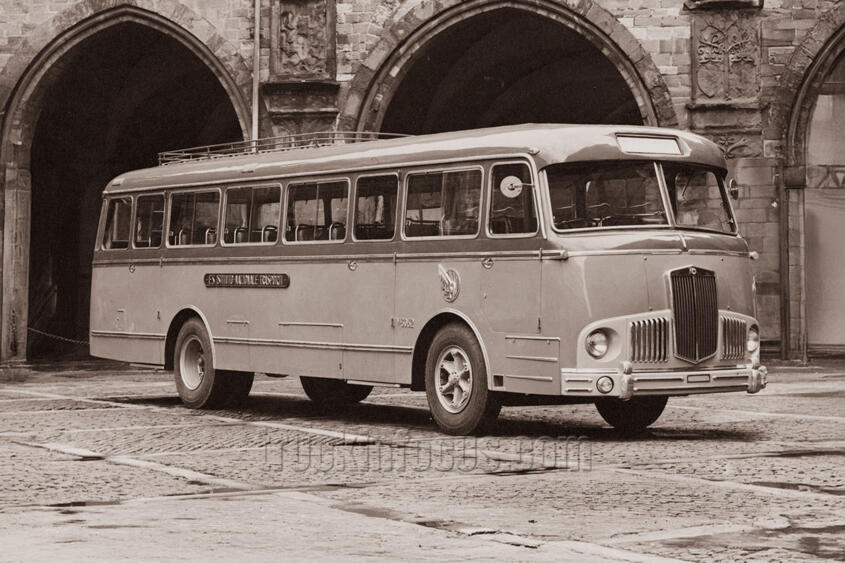
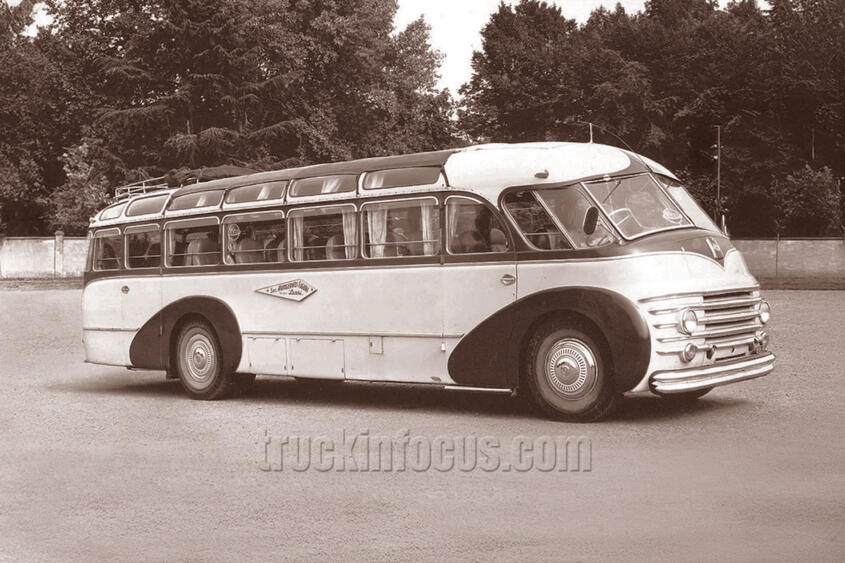
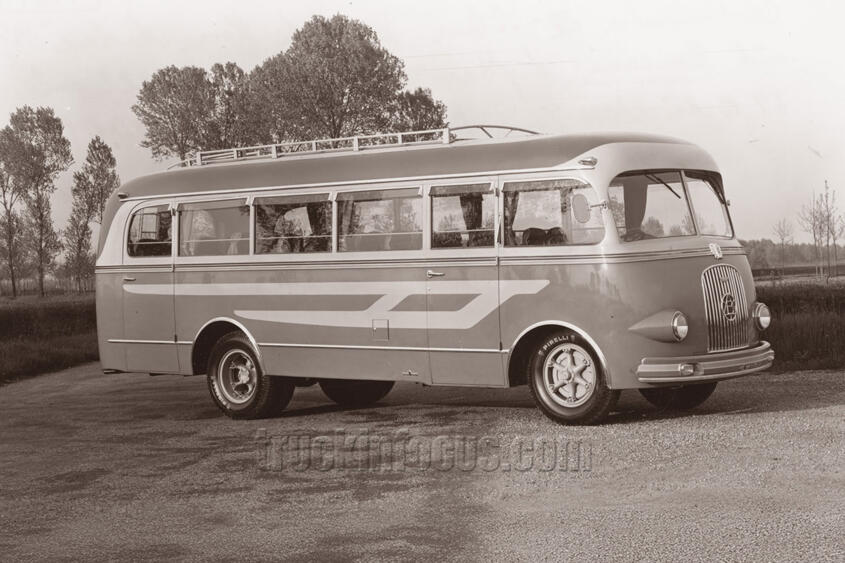
These four paragraphs cover all the basics of the subject. Any additional information that is available is contained in the captions. Unfortunately, the manufacturers of four of the bus bodies could not be identified. If you have any information that could help, please click here to send us an email.
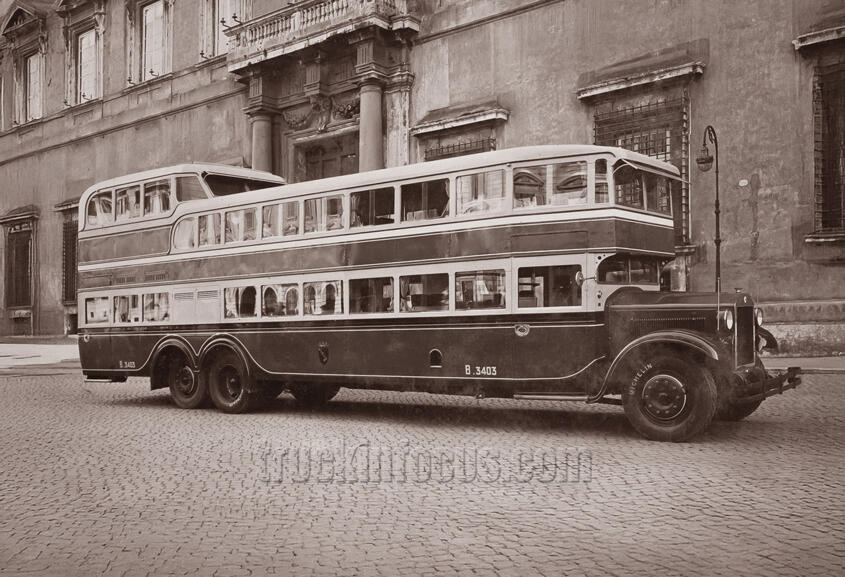
In this article, we begin with one of the most extraordinary buses ever to exist in Europe. Around 600 Lancia Omicron buses were built between 1927 and 1936, including two-axle versions. There are said to have been around 60 of the two-and-a-half-decker buses, such as the three-axle model pictured here with an unladen weight of nine tons. It is unclear which body manufacturer built the bodywork for this monster, but it was probably Macchi in Varese. The extremely long and tall bus with 86 seats ran between Rome and Ostia as well as to Tivoli, two towns in the suburbs of the Italian capital. Allegedly, a few examples of the Omicron two-and-a-half-decker were still in service after 1944, the year in which World War II ended for Italy.
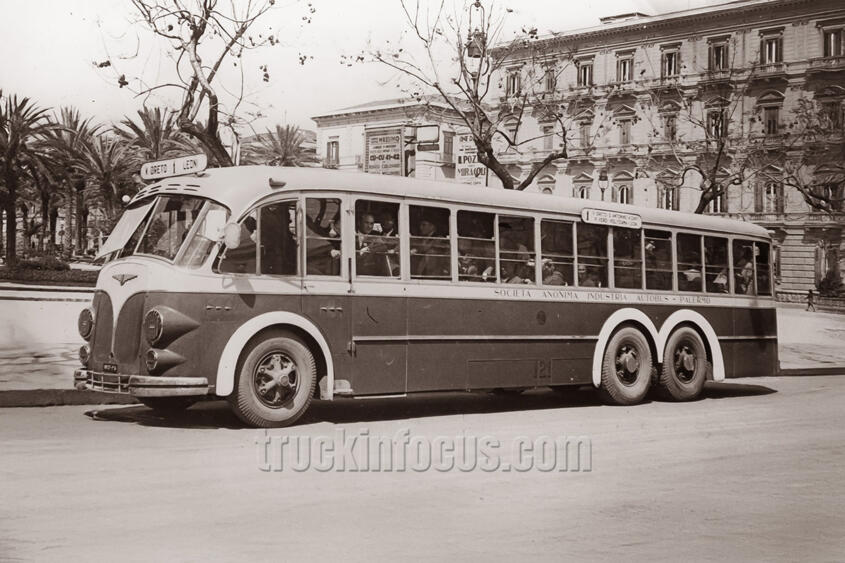
Another bus from the pre-war period is this FIAT 656 RNA 12, which was used in Palermo's city traffic with its 115 hp engine and a maximum speed of 52 kilometers per hour. The three-axle vehicle is said to have been built between 1939 and 1943. The photo was taken around 1943, and the headlights are covered with camouflage caps to protect against nighttime air raids.
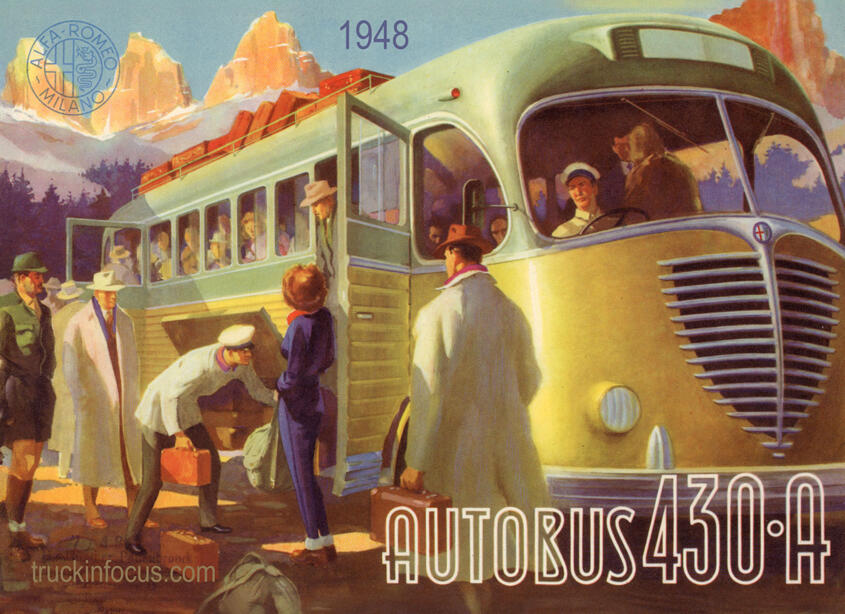
This is how the elegant world traveled in Italy – at least that's the impression conveyed by the artwork on the cover of this Alfa Romeo brochure. The bus advertised was the 430 A model, which was available from 1948 to 1953. Its 80 hp engine with a displacement of 5,816 cubic centimeters gave it a top speed of 77 kilometers per hour. There were versions for city, regional, and long-distance travel.
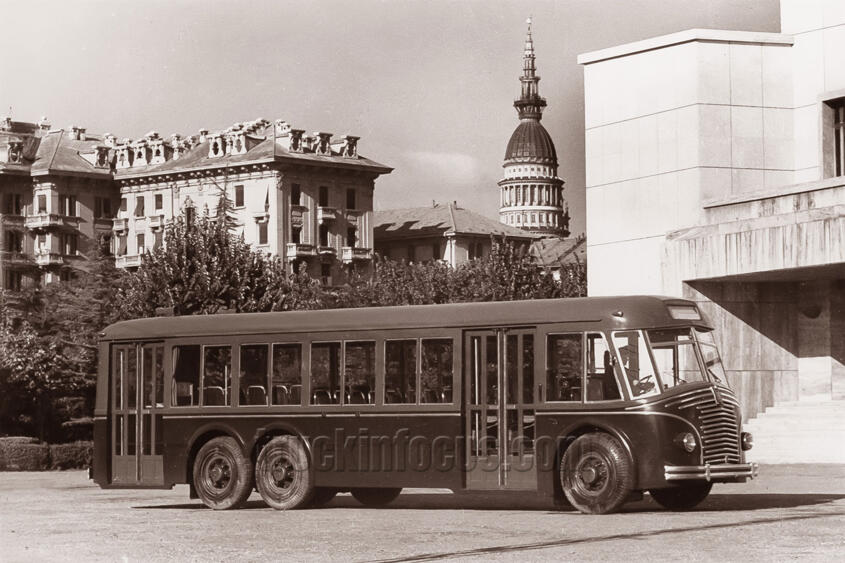
This bus, which was used in city traffic in Novara in the province of Piedmont, is one of the few whose body manufacturer we were unable to identify. It is possible that FIAT built the body itself. At least the bus type is known: it’s a FIAT 672 RN with a 123 hp 368 engine. The 12-meter bus could carry 100 passengers. In the background is the tower of the Basilica of San Gaudenzio, the landmark of Novara.
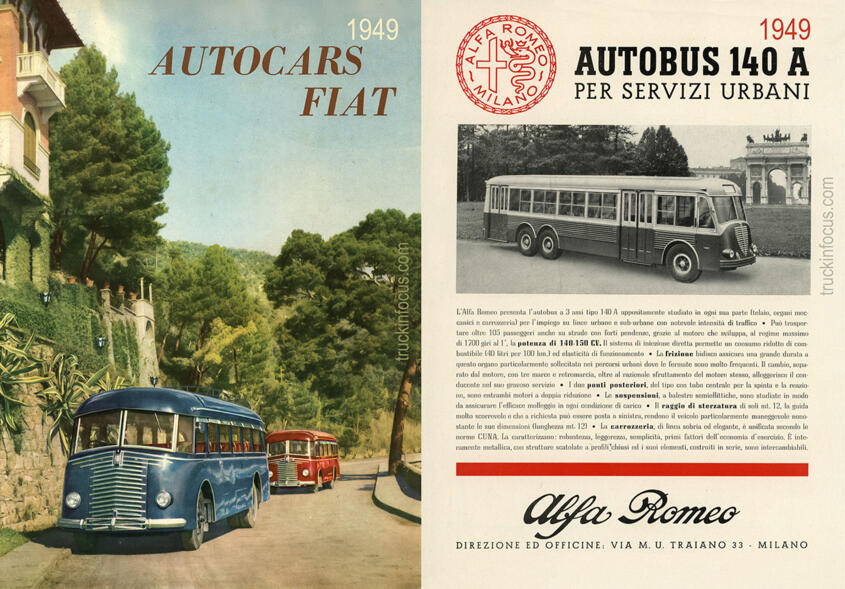
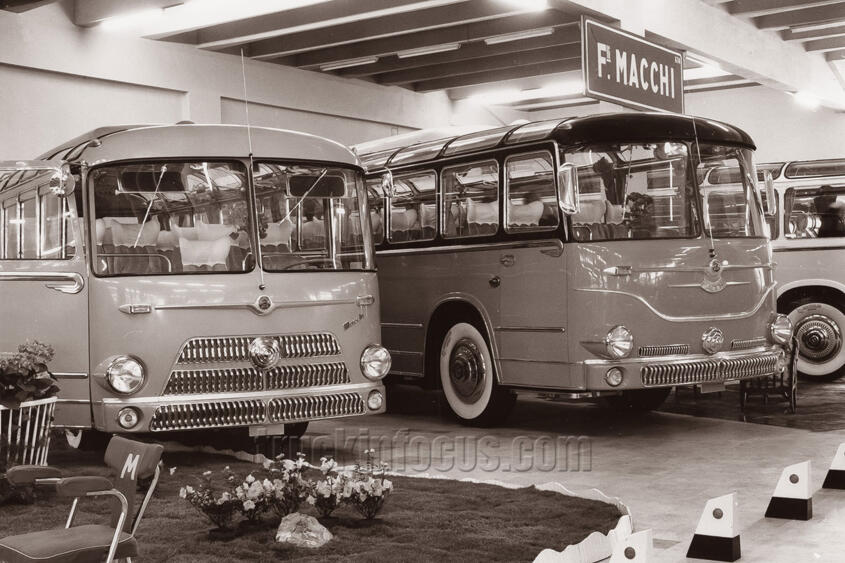
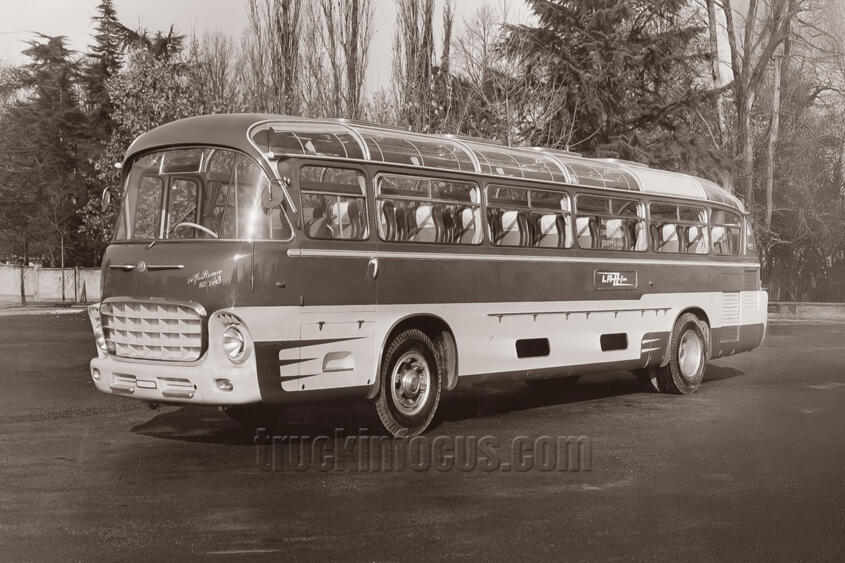
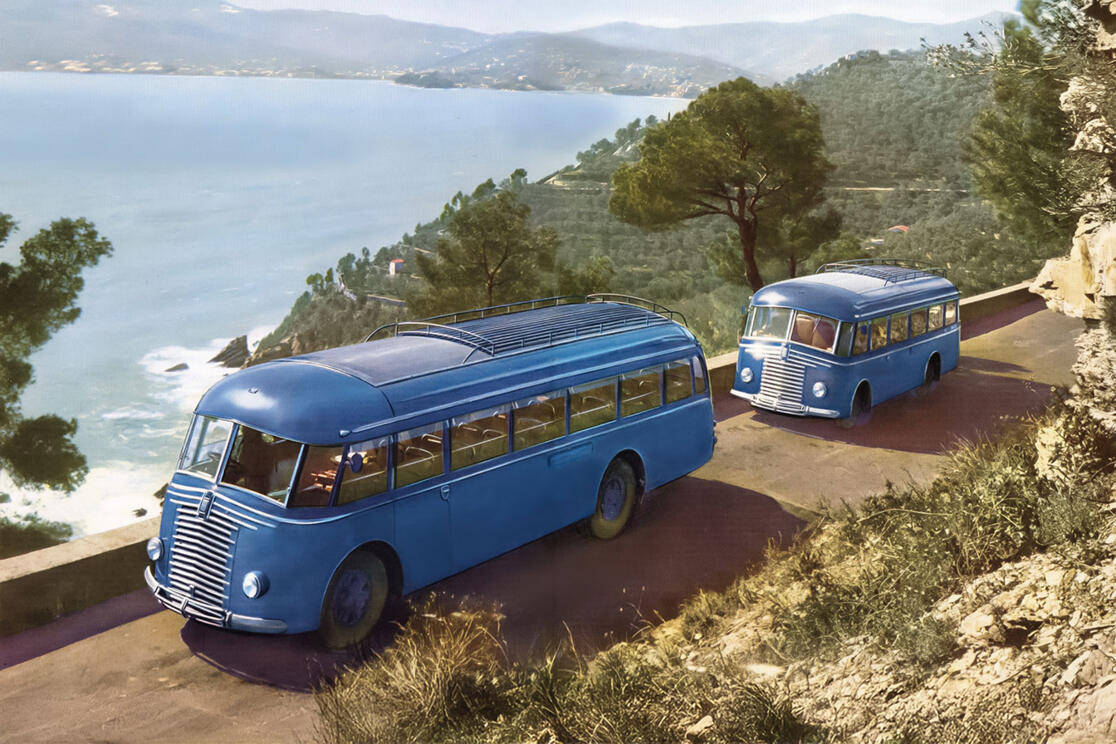
The 1949 brochure covers advertise the FIAT 626 RNL and 666 RN on the left. The buses differ in length (7.4 and 9 meters, respectively) and engines (type 326 with 70 hp and type 366/45 with 113 hp, respectively). The header image for this article also shows buses of these types. Next to it is an Alfa Romeo 140 A city bus, which could carry 105 people, 28 of them seated. The three-axle vehicle was equipped with a 1633 six-cylinder diesel engine with 150 hp.
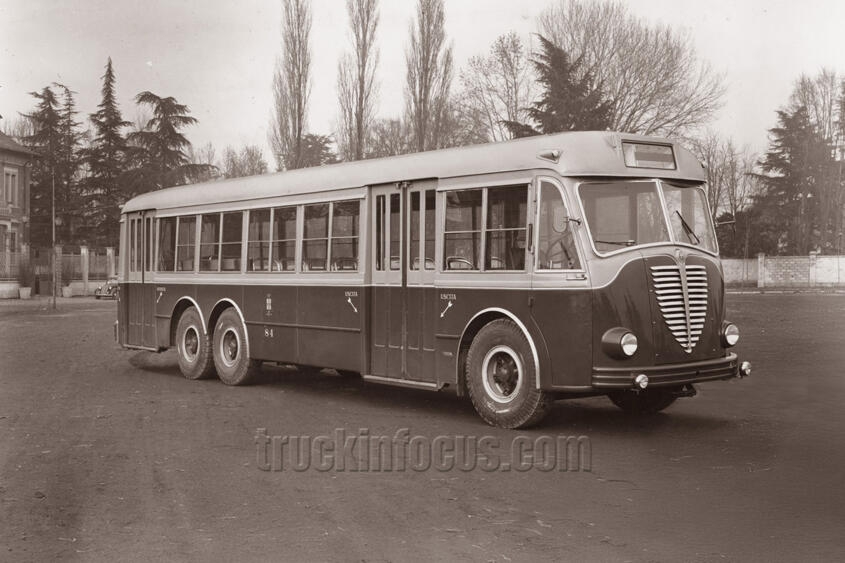
The Alfa Romeo 140 A was widely used in Italy in the 1950s and was standard equipment for many transport companies. Its body was designed by SIAI Marchetti, a company founded in Milan in 1915 under the name Società Idrovolanti Alta Italia (SIAI), which initially manufactured aircraft. In 1922, Alessandro Marchetti took up his position as the new chief engineer and had a decisive influence on the company's work for a long time. There is no information on the Internet about SIAI Marchetti's bus manufacturing. However, the book “Storia illustrata dell'Autobus Italiano” states that the company concentrated on bus manufacturing in the years after the Second World War. Other Italian aircraft manufacturers also took this step.
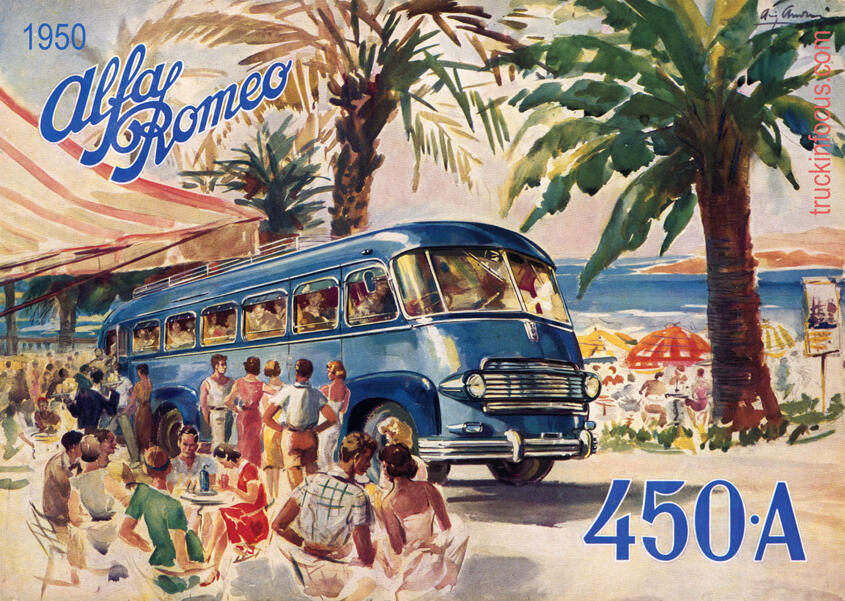
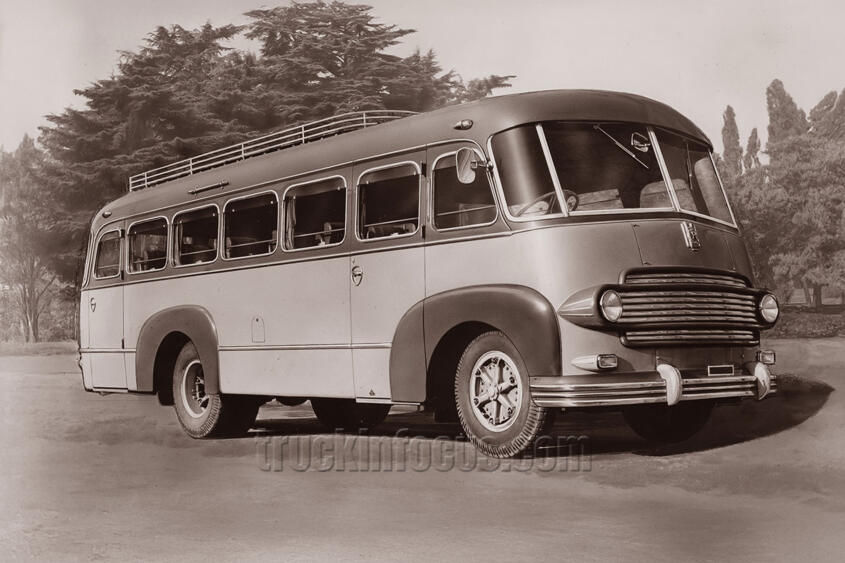
The two-axle Alfa Romeo 450 A bus was based on a truck model with the same type designation. It was very popular with operators and sold well. Its four-cylinder diesel engine with a displacement of 6330 cubic centimeters produced 90 hp. Depending on the area of application, the number of seats was up to 42.
This photo obviously served as a template for the graphic designer for the brochure illustration shown above. The Alfa Romeo 450 A could be purchased from the manufacturer as a chassis with an engine. The model shown in the photo was fitted with a bus body by Carrozzeria Barbi. In addition to the harmoniously shaped radiator grille, the slightly raised fenders are particularly striking. Galileo Barbi founded his workshop in 1905 in Concordia Sagittaria (near Modena) as a manufacturer of horse-drawn carriages. In 1927, he moved to Mirandola. From the 1920s onwards, Barbi built bodies for Fiat and Alfa Romeo cars. From 1931 onwards, the company focused on commercial vehicles and bus bodies with steel frames. Today, the company operates as Barbi Coach & Bus srl in Mirandola and sells buses and spare parts.
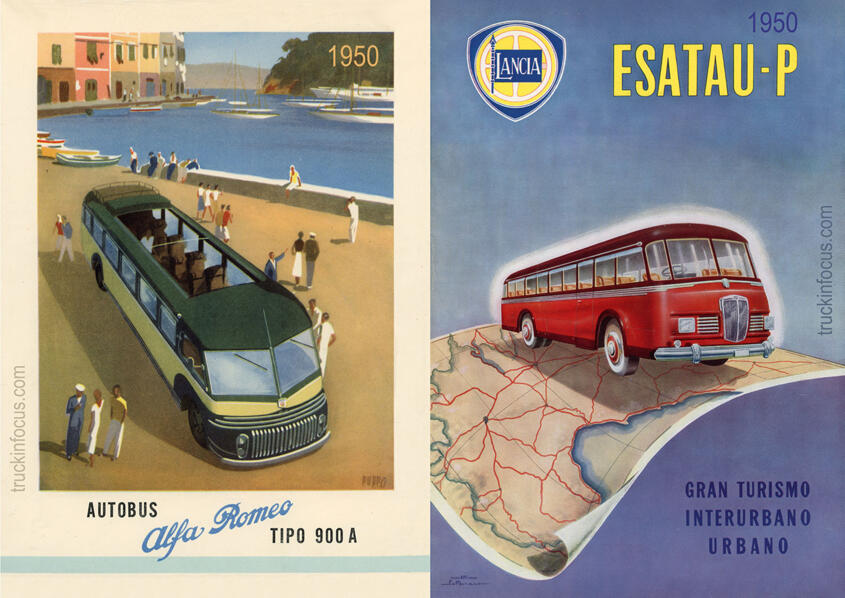
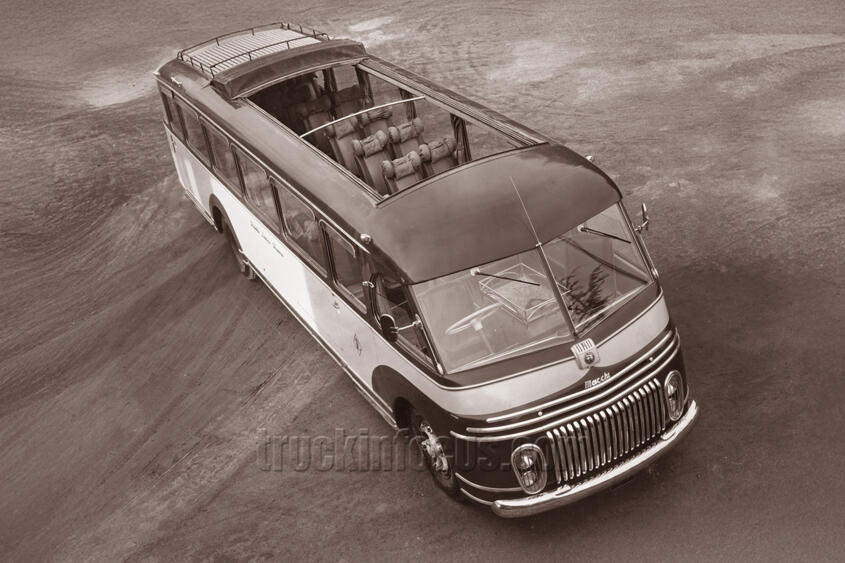
The Alfa Romeo Type 900 A was built from 1950 to 1956. The exact construction period of the Lancia Esatau-P is not documented, but can be narrowed down to approximately 1950 to 1957. Both advertising brochures show bodied chassis with superstructures from different manufacturers, depending on customer requirements.
It is obvious that this photograph also served as a template for the graphic designer for the brochure shown above. The Alfa Romeo 900 A's chrome-trimmed body with open sunroof was manufactured by Fratelli Macchi. The company was founded in Varese at the end of the 19th century by brothers Giovanni and Agostino Macchi and originally specialized in the repair and construction of trailers and horse-drawn omnibuses. In 1905, the founders' sons invested in new technologies for manufacturing car bodies. In the following decades, numerous bodies for buses were produced on the chassis of all Italian commercial vehicle manufacturers as well as foreign companies such as Büssing from Germany. The principle of the articulation system for buses can be traced back to the Macchi design office; the patent application for this was filed in 1934. The company ceased trading in 1975 due to financial difficulties in the Italian bus bodywork industry.
This 1950 Lancia Esatau-P was built by C.A.B. (Cantieri Aeronautici Bergamaschi) in Ponte San Pietro in the province of Bergamo. The company was founded in 1920 under the name Airone, adopted its new name in 1927, and became part of the Caproni Group in 1929. It produced several famous aircraft, including the Ca.309 “Ghibli.” At the end of World War II, the entire Caproni Group fell into crisis due to a lack of orders. Therefore, an attempt was made to restructure all the companies in the group. At C.A.B., skilled sheet metal workers were employed to build bodies for buses and ambulances. However, this attempt was unsuccessful. After all loans had been used up, the Caproni Group was gradually liquidated. C.A.B. closed in 1954.
This body is a very special gem. Hidden beneath the streamlined bus body is an Alfa Romeo 800 A. The body was manufactured by Ambrosini & Botta, a company based in Bizzozero in the province of Varese. The owners were Giuseppe Botta and Alessandro and Luigi Ambrosini. Production focused mainly on buses, but aircraft and sports cars with chassis and engines from the leading automobile manufacturers were also bodied. The company was active from 1911 to 1954.
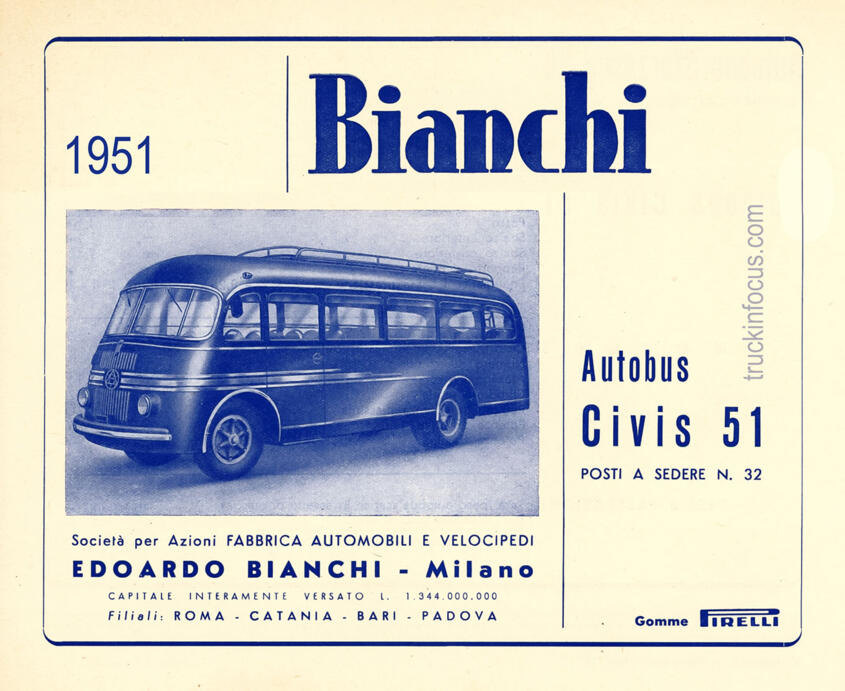
The Bianchi company was founded in Milan in 1885 by Eduardo Bianchi. Initially, the company repaired bicycles, but soon began manufacturing them as well. In 1905, the company also began producing automobiles. During World War II, the factory was destroyed by bombs. When it was repaired in 1946 and production was about to resume, Edoardo Bianchi was killed in a car accident. The company attempted to gain market share by designing cars and buses, but it was unable to maintain its position as a motor vehicle manufacturer for long. This led to a partnership with Fiat and Pirelli in 1955 under the Autobianchi brand. In 1980, the company lost its independence and became part of the Piaggio Group.
This photo of a 1952 Bianchi Andax bus shows Bianchi's efforts to gain a foothold in the bus sector in the 1950s. The chassis and 84 hp engine came from Bianchi, while the rather simple bodywork was manufactured by Carrozzeria Gaetano Borsani & C., based in Cornaredo near Milan. The company produced bus bodies and trailers from 1922 to around 1986, working closely with chassis manufacturers such as Isotta Fraschini, OM, and FIAT. In addition to normal buses, Borsani also produced special vehicles such as bus semi-trailers for use at airports.
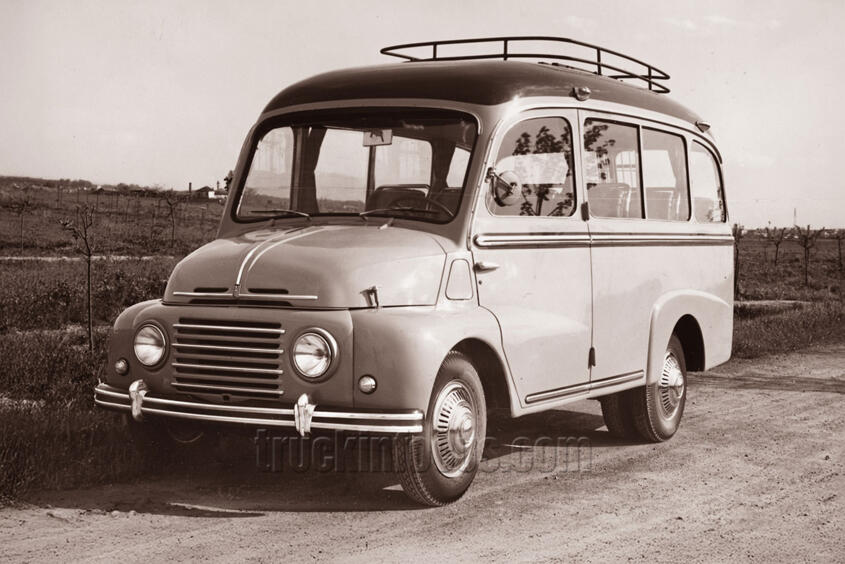
This minibus is based on a FIAT transporter with the model designation 615 N. It was available from 1951, and from 1953 a version was offered as a chassis for bus bodies. Unfortunately, we were unable to find out which manufacturer produced the cute body with presumably eleven seats.
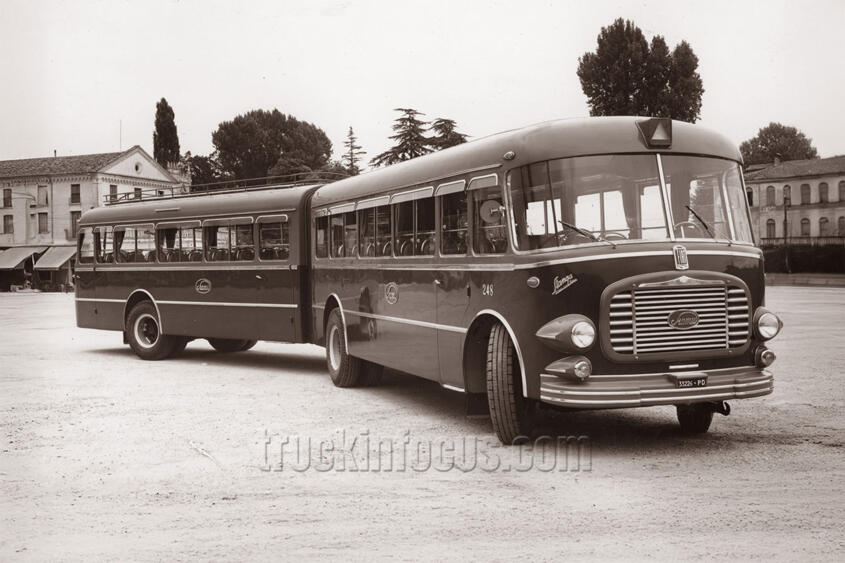
This 17.5-meter-long articulated bus from 1953 with a FIAT 680 RN railcar chassis could carry 90 passengers plus the driver and conductor. The trailer and body were manufactured by Stanga (Officina Meccanica della Stanga) from Padua. The company was founded in 1949 by brothers Gianfranco, Sandro, and Camillo Stanga and produced tram cars and buses as well as trucks under license, for example from MAN. Stanga was active until the 1980s but ceased to exist as an independent company in 1993 when it was integrated into the Firema consortium. As a result of a corporate crisis, the Padua plants finally closed in 2003, leaving 280 employees unemployed.
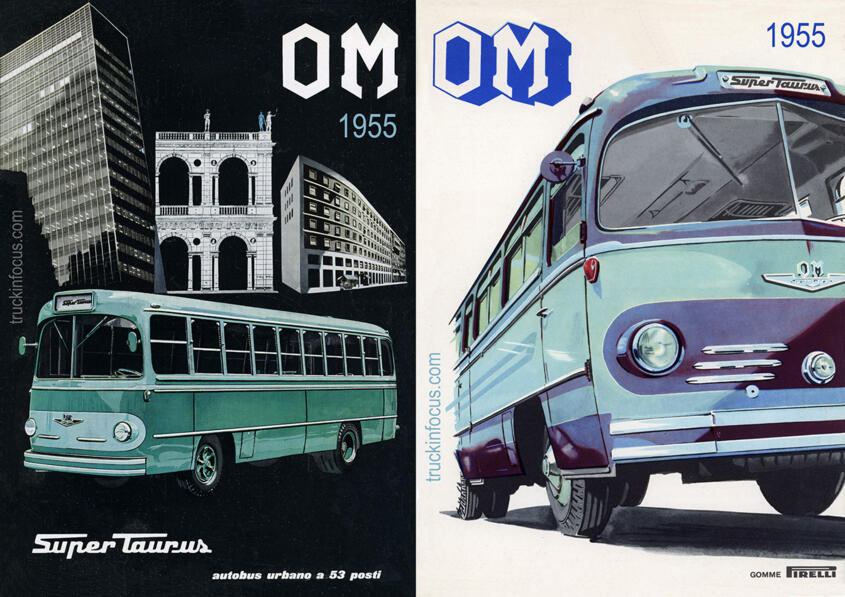
Both OM brochures from 1955 advertise the OM Super Taurus: on the left as a city bus and on the right as a coach. It is not known which company manufactured the bodies shown.


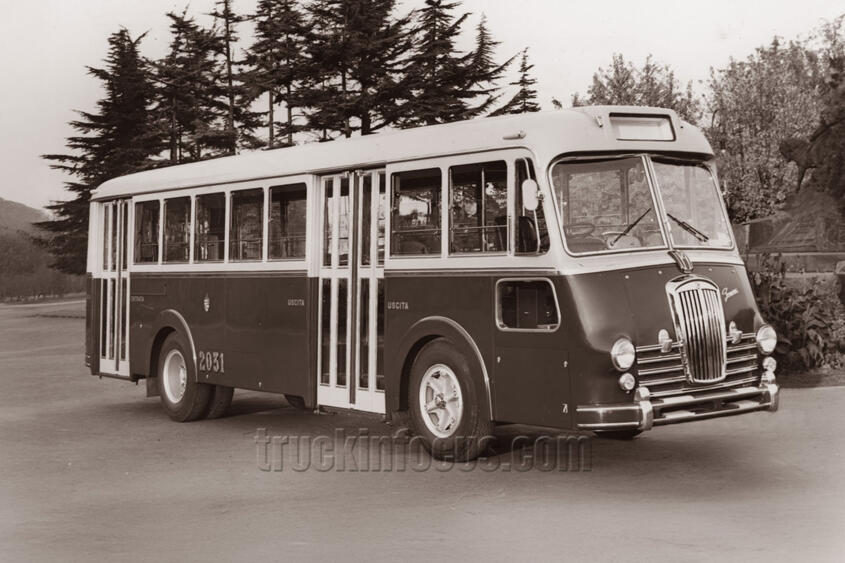
This photo shows a 1955 Lancia Esatau P with a front-mounted 132 hp Lancia V10 underfloor engine. The body of the city bus was made by Carrozzeria Garavini in Turin. The company was active from 1914 to 1957. The founder, Eusebio Garavini, had previously worked for a railway carriage manufacturer and other bodywork manufacturers. He specialized in the construction of bus bodies. During the Second World War, he also built electric-powered military vehicles on behalf of the Italian state. After his death in May 1947, his sons Aldo and Sergio took over the business. However, the company was unable to establish itself permanently. In 1957, it was taken over by its competitor Officine Viberti.
At the Turin Motor Show in 1955, Macchi presented two self-supporting coaches with Büssing drive and chassis components in an underfloor arrangement. The buses were designated Macchi-Büssing 4500 T and 6500 T.
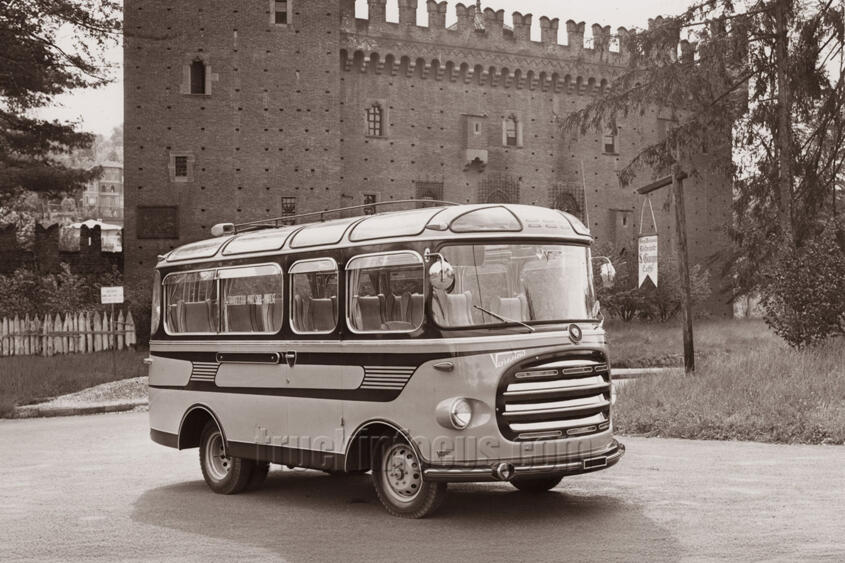
The small Beta Diesel minibus from Lancia dates from 1955. Its two-cylinder two-stroke engine produced 41 hp. The body of the two-ton bus was made by Carrozeria Varesina, a company founded in 1845 in Varese, Lombardy. In the early years, the company manufactured carriages and fitted out carriages for heads of state. With the advent of motorization at the beginning of the 20th century, the company specialized in car bodies and the first buses. During World War I, the company suffered severe damage. It resumed operations with great difficulty. All Italian manufacturers such as Itala, Isotta Fraschini, Alfa Romeo, Fiat, OM, and even foreign manufacturers had luxury cars bodied there. At the beginning of the 1920s, however, the company abandoned automobile manufacturing to concentrate on the construction of commercial vehicle bodies, especially luxury coaches. At the end of the 1960s, the company ceased operations.
This Lancia Esatau-P, bodied by Macchi around 1955, was also powered by a front-mounted Lancia V 10 underfloor engine with 132 hp.
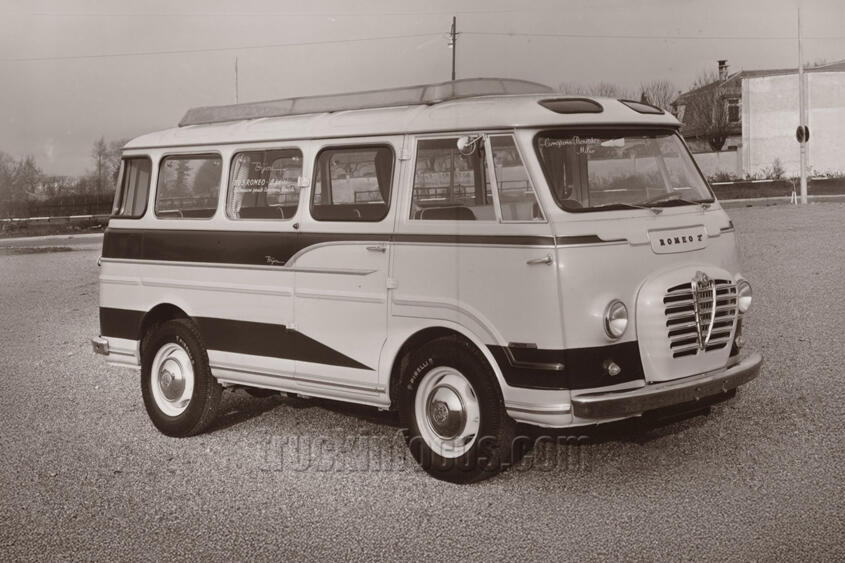
The Alfa Romeo “Romeo 2“ was available in 1958 with a four-cylinder engine with a displacement of 1290 cc and 37 hp or, alternatively, with a two-cylinder diesel engine with a displacement of 1158 cc and 31 hp. The body of the minibus shown here was built by Carrozzeria Boneschi in Cambiago, Lombardy. Founded in 1919, the company initially built mainly bodies for Lancia cars. The Italian government was a customer for the “Ministeriale” version of the Astura sedan. In the early 1960s, the company was taken over by Fiat subsidiary Carrozzeria Savio and from then on concentrated on bus and commercial vehicle bodies, ambulances, and armored cash transporters. In 2006, the facilities in Cambiago were sold. The Boneschi brand name still exists today and belongs to the Savio Group, which in turn belongs to Omnia Holding.
This 1958 Alfa Romeo 902 AS with a rear-mounted 130 hp engine and 9,500 cc displacement was styled in the design language of American passenger cars. The elaborate front and roof edge glazing and the entire front end were certainly not cheap. The body was manufactured by De Simon. The company was founded in 1925 by Giovanni De Simon in Osoppo in the province of Udine as a body manufacturer for buses. In 1976, it suffered severe damage in the Friuli earthquake, but was rebuilt under the leadership of Ilvo De Simon. Since 2006, the company has specialized in the production and distribution of spare parts as well as the repair, maintenance, and conversion of bus and truck bodies.
The last photo in the first part of our article on Italian buses from the 1950s and 1960s shows another Alfa Romeo 902 AS with a 130 hp engine in the rear. The bus was bodied by Autodromo, a company founded in Modena in 1949. In its early years, Autodromo (Carrozzeria Autodromo Modena) was a repair shop for automobiles. The transition to body manufacturer took place gradually. In the 1950s, Autodromo initially built a few bodies for racing cars. From around 1960, the company mainly produced bodies for city buses, which were marketed under the name CAM. In the late 1990s, Autodromo ran into financial difficulties, but continued to exist until 2003.

You might also be interested in: